A village that looks out to sea—and works on it
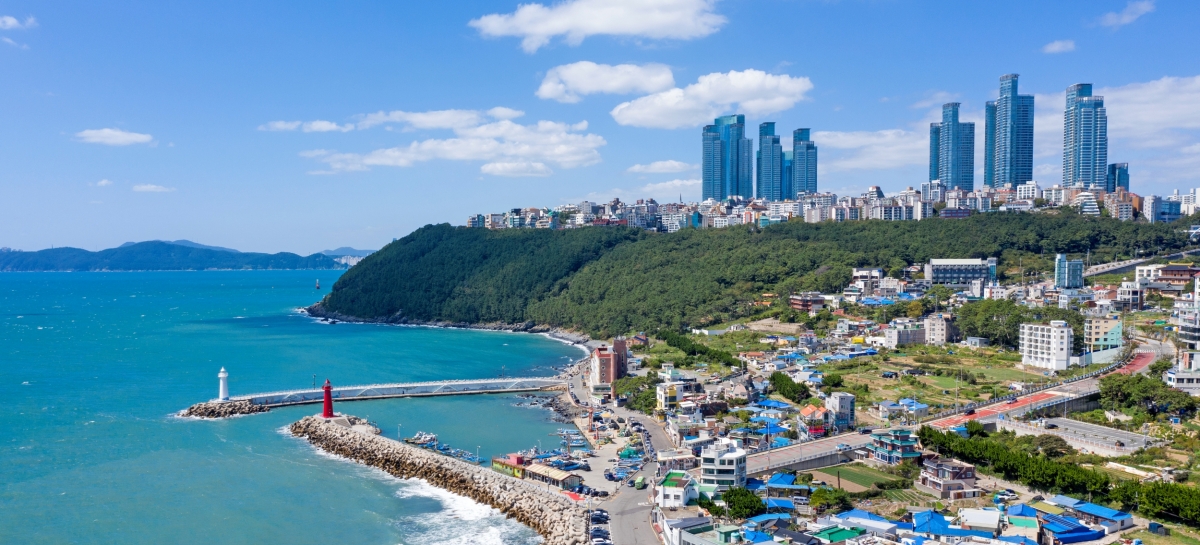
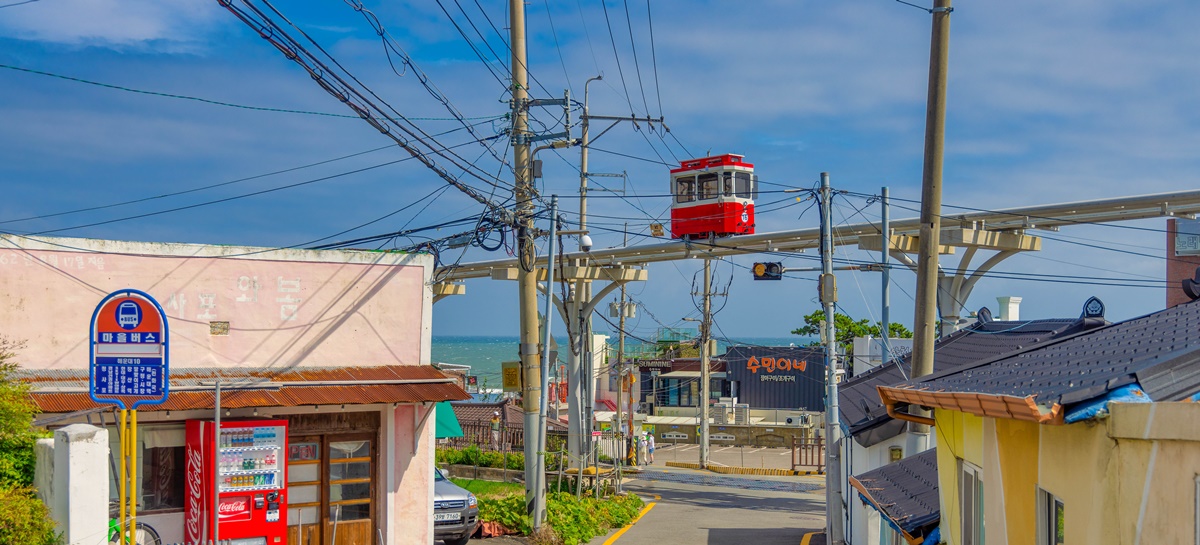
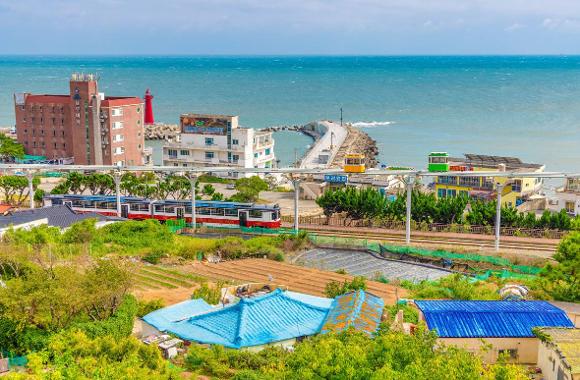
Cheongsapo often appears in photographs as a colourful Sky Capsule floating above the coast, or a railway crossing at the bottom of a street that seems to lead straight into the sea. Both are memorable, but neither tells the whole story. Between Haeundae’s broad beach and Songjeong lies a working harbour, framed by red and white lighthouses and backed by houses and restaurants climbing the hillside. Visitors sip coffee while fishing boats and harbour work continue outside. Moving between the waterfront and the village reveals a useful distinction: in Busan, the sea is both a holiday landscape and somebody’s workplace.
This is not a visit organised around a single summit or exhibition. Its pleasures accumulate: a harbour walk, a view through the floor of Daritdol Skywalk, a seat beside a café window, a meal cooked over a grill. A photograph-only stop can be brief, but allow half a day if you want a coastal walk and a proper meal. The timings below are planning suggestions, allowing for different walking speeds and queues. You do not need to use every attraction. Decide whether you most want to be close to the water or above it, then choose the transport and spending that support that experience.
From Jangsan metro station to the harbour
Jangsan Station on Metro Line 2 is a convenient starting point, but the metro does not reach Cheongsapo’s waterfront. You still need a local bus or taxi for the final stretch. One published route uses Exit 7 at Jangsan, the Haeundae-gu 10 village bus, and the stop called Syupeo-ap, written 슈퍼앞. From there, Cheongsapo railway station is approximately two minutes away on foot. Save both 슈퍼앞 and 청사포정거장 in your map app; the Korean names are useful when choosing between similarly named results. Check the live route and bus-stop location on the day, since transport arrangements can change.
For a taxi, show “청사포정거장, 부산 해운대구 청사포로 116”: Cheongsapo Station, 116 Cheongsapo-ro. Daritdol Skywalk has a different address, 167 Cheongsapo-ro, if you are heading directly there. The road from Jangsan crosses a hill before descending towards the sea, so a short-looking map distance is not a good reason to drag a large suitcase along it. Plan the return as well. Will you come back to the station for a bus, or continue by Beach Train towards Mipo or Songjeong? That decision helps determine the order of your walk. If you have not booked a tourist-railway ride, check the remaining departures when you arrive.
Reading the harbour between two lighthouses
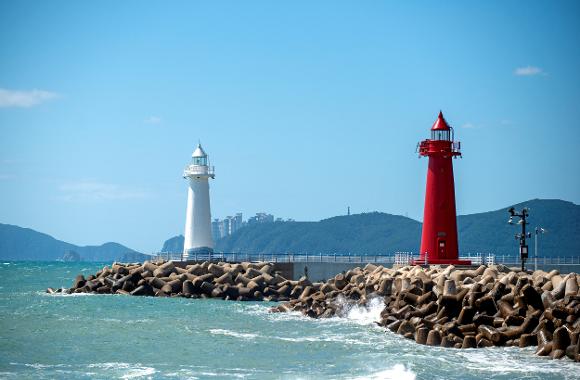
The red and white lighthouses provide immediate landmarks. Rather than framing only one tower, include the breakwaters, moored boats and hillside houses to understand the village’s scale. From the outer side, the structures meet the open sea; from the inner harbour, sheltered water and tied-up boats dominate the scene. Start in the public pedestrian areas with railings and look in both directions. Calm water does not turn a fishing harbour into a swimming beach. Leave space for people working and vehicles passing through, even when the waterfront looks like a convenient place to stop for a photograph.
A local story associated with Mangbusong, the “waiting-for-her-husband” pine, tells of a fisherman’s wife watching for his return. Read it as a village legend expressing the emotions of families waiting for boats, rather than a verified biography. The same sea means something different to a visitor taking a lighthouse portrait and to somebody awaiting a family member. With that context, ropes and nets become more than picturesque objects. Do not handle fishing equipment or climb onto boats, and ask before making an identifiable person the subject of a photograph. This small adjustment in attention makes the harbour much more interesting than a collection of backdrops.
The famous crossing is a working railway
At Cheongsapo’s much-photographed crossing, the descending street opens towards the sea while a train passes across the foreground. Coloured carriages, rails, buildings and overhead wires bring tourism infrastructure and an ordinary neighbourhood into the same frame. Some photographs invite comparisons with seaside crossings in Japanese animation. A visual resemblance, however, does not establish that this is the setting of a particular work. Cheongsapo already has its own story: its topography, its village streets and the railway operating here today. There is no need to add an unverified film-location claim to make the view compelling.
Stop in a pedestrian area outside the tracks, obey the barriers and signals, and avoid stepping backwards into traffic while looking at your screen. Without a train, you can photograph the sea at the end of the street; as one passes, you can frame the relationship between the carriage and the village. Neither requires standing in the road. If you want to wait for another train, consider how that fits your companions’ day. Spending all your time at the crossing can mean missing the harbour a short distance away. Use the scene as an introduction, then let the waterfront and coastal walk broaden your impression of Cheongsapo.
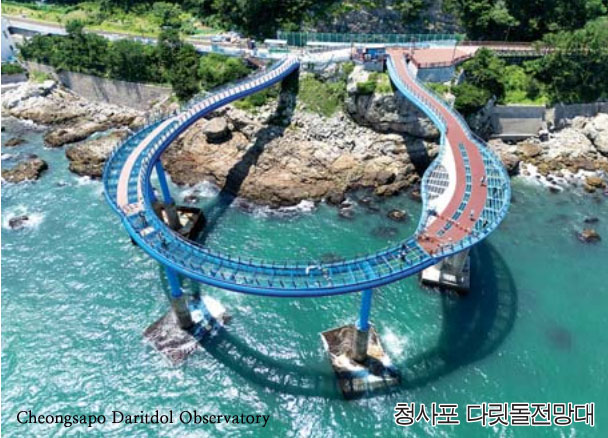
Daritdol Skywalk and the five rocks behind its name
Daritdol takes its name from five reefs extending out from the coast like stepping stones. Before concentrating on the transparent floor, look along the rocks and shoreline: the name becomes easier to understand in the landscape. The skywalk opened in 2017 and was expanded in 2024, changing from the earlier 72.5-metre structure to a U-shaped route with a total length of 191 metres. That explains why older photographs showing a straight projection into the sea differ from the present layout. Haewol Skywalk, elsewhere along the railway, is a separate attraction; check the name when choosing map results or photographs.
Out above the water, both your viewing direction and your relationship to the shore change. Look at the waves beneath the transparent sections, but also turn back towards the village and rocks. Follow the entrance instructions for protective overshoes and walking on the structure. A companion uncomfortable with heights need not be persuaded onto the glass: the landward viewpoint is an enjoyable alternative. Strong wind, rain, snow or other unsafe conditions can restrict access, and free admission does not mean unrestricted entry at every hour. Make the skywalk one part of a varied visit so that a closure does not leave you without a worthwhile day.
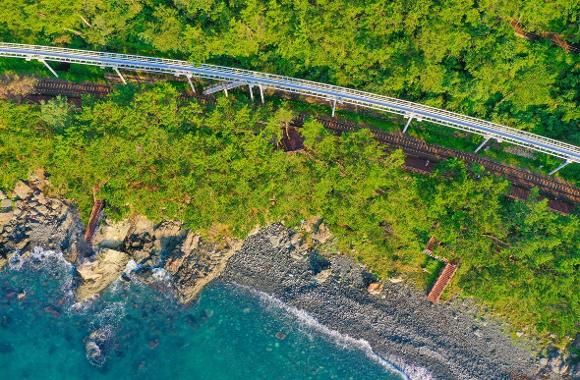
Following the Green Railway and pebble coast
Cheongsapo’s coastal paths connect with the Green Railway, developed along the former Donghae Nambu railway corridor. The Mipo–Songjeong coastal stretch is approximately 4.8 kilometres, but there is no obligation to walk all of it. Start by linking the harbour and Daritdol, then extend towards Gudeokpo or Mipo if time and energy allow. A particularly important distinction concerns older travel accounts describing walks along abandoned tracks. Tourist trains now operate here. Use the designated pedestrian route, keep it separate from the operational railway in your mind as well as under your feet, and cross only at authorised crossings.
The Mongdol pebble shore offers a different texture from Haeundae’s sand: rounded stones, rocks and short breaking waves. You can appreciate that contrast from the walkway without descending to the water. Loose or wet stones can move and become slippery, so wear shoes suited to walking and remain clear of the reach of the waves if you approach the shore. Leave the stones where they are; photographs and the sound of the water make better souvenirs. When adding this stretch to your plan, count the return distance too. A café break is a welcome part of the afternoon, but it is not additional walking time hidden inside the same hour.
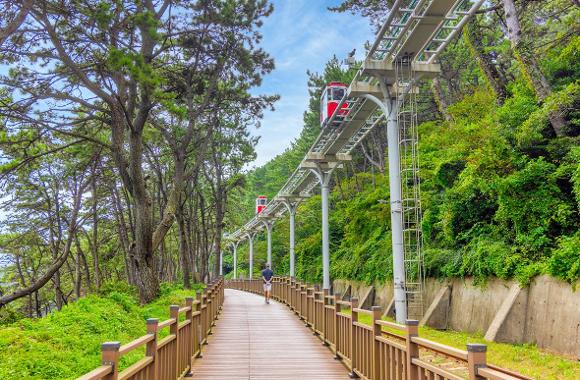
Beach Train or Sky Capsule?
The two attractions appear in similar photographs, yet their routes and purposes differ. The Beach Train runs approximately 4.8 kilometres from Mipo through Cheongsapo to Songjeong, sharing its carriages among visitors. Intermediate stops include Dalmaji Tunnel, Haewol Skywalk, Daritdol Skywalk and Gudeokpo, making it useful for a visit spread across several coastal locations. The advertised end-to-end journey is about 25 minutes one way, excluding queues and boarding. It is both a sightseeing experience and a way of getting somewhere. If you intend to get off and later board again, choose a ticket that permits that pattern from the outset.
The Sky Capsule is a small cabin travelling on an elevated track for approximately two kilometres between Mipo and Cheongsapo. Its roughly 30-minute one-way ride emphasises a slow view shared with your own group. It does not take you directly to Songjeong or Daritdol; after arriving at Cheongsapo, you continue on foot or by another means. Arriving by capsule from Mipo and exploring afterwards works well, as does visiting the village first and taking a capsule to Mipo. Neither arrangement automatically includes a return journey. Check the departure station, direction, date and time slot individually before finishing your booking.
Understanding tickets and the real cost of your route
As checked in October 2026, a standard Beach Train single-boarding ticket costs KRW 10,000 from Mipo or Songjeong, or KRW 8,000 from Cheongsapo and intermediate stops. The two-boarding ticket is KRW 14,000 and the all-stations ticket KRW 16,000. “All stations” does not mean unlimited travel: it permits one boarding at each station, up to seven in total. Everyone must alight at the Mipo and Songjeong termini. A single-boarding ticket is unsuitable if you want to ride from Cheongsapo to Daritdol, get off, then continue by train to Songjeong. Equally, the more expensive ticket is not automatically better if you will ride once and walk afterwards.
Standard Sky Capsule fares are per cabin: KRW 50,000 for two people, 55,000 for three and 60,000 for four. Confusing a cabin price with a per-person fare changes a budget considerably. For two people, a two-person one-way capsule plus one Beach Train boarding each from Cheongsapo totals KRW 66,000 for those attractions. Meals, drinks and city buses or taxis are additional. A visitor arriving by bus and walking around the harbour and skywalk need not buy a tourist-railway ticket at all. Discounts, packages and prices can change, so check the final booking conditions. First deciding exactly which journeys you want makes that comparison much simpler.
Ordering a shellfish grill without guessing
Grilled shellfish, or jogae-gui, is one of the meals closely associated with Cheongsapo. Watching the shellfish cook turns eating into time spent together, rather than a quick stop between attractions. Photographs may show scallops, assorted shells, sauces or cheese, but combinations and preparation vary by restaurant. A menu item labelled modeum means an assortment; it does not guarantee every seafood item appearing in a promotional image. Before ordering, ask what the platter includes, whether the displayed price is per platter or per person, and whether the portion is appropriate for your group. These details matter more than the apparent size of a dish in a photograph.
Useful Korean questions include “이 가격이 두 사람 전체 가격인가요?”—is this the total price for two people?—and “직접 구워야 하나요?”—do we cook it ourselves? “치즈와 양념을 빼 주실 수 있나요?” asks whether cheese and seasoning can be omitted. Check whether rice, noodles and drinks cost extra. Shells and grills become hot, and different shellfish cook at different rates; ask staff to explain when to turn and eat them if this is unfamiliar. Anyone with seafood allergies or dietary restrictions should confirm ingredients and cooking arrangements, rather than rely on pictures. The accompanying images illustrate the food and its presentation, not a claim that the writer has personally tasted a particular restaurant’s current menu.

Choose a café by the view you actually want
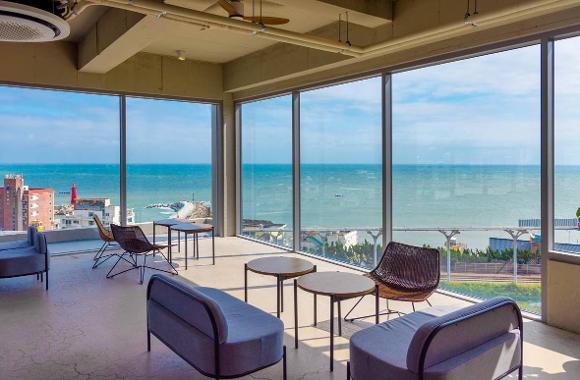
“Sea view” is not a very precise way to choose a café in Cheongsapo. Do you want the harbour and lighthouses, trains and capsules crossing the scene, or a broad horizon with fewer buildings? Location and floor level change the answer. Photographs of the neighbourhood’s cafés show how different an indoor window seat and an outdoor terrace can feel. A window provides a sheltered view but can reflect the room in your pictures; a terrace brings you closer to the weather, including strong sun and wind. Look at the available seating and each floor’s access arrangements before ordering, rather than assuming every seat matches the best photograph.
The café need not be merely a gap between attractions. After walking at water level, looking down towards the harbour helps you understand the route you have just taken. Also consider whether an attractive dessert is enough to replace a meal and whether everyone can find a suitable drink. A staircase-only floor or rooftop may not work for a companion with limited mobility. Do not assume that a business shown in an older photograph still offers the same menu or seating; check its current arrangements. A good stop combines a worthwhile view with genuine rest, while leaving other visitors room to enjoy the place as well.
A half-day plan for a first visit
If arriving by metro and bus, begin at Cheongsapo Station by confirming any reservation and your onward transport. Allow roughly 30–45 minutes for the harbour and lighthouses, then 60–90 minutes for the coastal route towards Daritdol and the skywalk area. These are generous planning allowances for walking out and back, photographs and a short wait, not official tour durations. In strong wind, shorten the skywalk stop and return towards the village. Adding around an hour for lunch or an early dinner and another 30–60 minutes for a café produces a balanced half-day, with both movement and pauses rather than a continuous race between photo spots.
If your capsule booking anchors the day, reverse the logic: ride from Mipo, explore the harbour, eat, visit Daritdol and return to Jangsan by bus. For a longer coastal journey, continue from the skywalk towards Songjeong by Beach Train, checking your reboarding allowance and remaining departures. A one-way itinerary reduces retracing but needs more thought about luggage and the trip back. Combining Haeundae Beach, Cheongsapo, Songjeong and distant night views in one day can make each place feel like a brief transit stop. Pick one experience in Cheongsapo that deserves unhurried time, then protect that part of the schedule when queues or weather intervene.
Preparing for the season and the time of day
Clear weather brings out the contrast between the horizon and coloured lighthouses, but exposed coastal sections offer limited shade. In summer, carry water and sun protection and divide longer walks with indoor rest or a meal. In winter, the wind can feel colder than the temperature suggests; layers and a bag that leaves your hands free are useful. Light rain does not necessarily stop the railway, but railway operation and skywalk access are separate decisions. If heavy rain or strong winds are forecast, increase the indoor portion of the visit instead of building the entire day around a structure above the sea.
For evening photographs, compare sunset with your final transport options before setting out. A skywalk remaining open late does not mean the Beach Train or Sky Capsule runs until the same time. Capsule closing times vary by season, so do not assume you can photograph the night scene and then board immediately. After dark, village lights contrast with the coastline, but rocks and distant features visible in daylight may disappear. On a first visit, arriving early enough to understand the harbour and coastal layout is helpful. Stay into the evening if the weather and your return arrangements leave room, rather than allowing a desired photograph to dictate an uncertain journey home.
Adjusting the visit for wheelchairs, pushchairs and luggage
A connected coastal path is not the same as a uniformly accessible route. Check slopes around the harbour, the skywalk entrance and stairs inside individual restaurants and cafés separately. For a wheelchair user, a shorter itinerary linking the station, accessible public waterfront space and a suitable café may work better. The operator says manual wheelchairs can be used on the Beach Train, whereas they must be folded for the Sky Capsule; powered wheelchairs cannot board either attraction. The ability to transfer and the assistance required therefore matter. Explain your particular needs before booking, rather than treating a general photograph of a level platform as proof that every part of the journey will work.
Pushchairs also need to be folded for both rail attractions, so consider how the group will carry a child and bags at the same time. Lockers are listed at Cheongsapo Station, but availability in the required size is not guaranteed. Leaving a large suitcase at your accommodation and carrying a smaller bag makes both walking and boarding easier. Locate toilets and any baby-changing facilities when you arrive, before walking away along the coast. There is no obligation to make a companion struggle through both the skywalk and a capsule ride. Choosing one comfortable place where everyone can share the harbour view can be a more rewarding way to experience Cheongsapo together.
Addresses and opening information to save
Cheongsapo Station is at 116 Cheongsapo-ro, Haeundae-gu, Busan. Blueline Park’s enquiry number is 051-701-5548, or +82-51-701-5548 internationally. Daritdol Skywalk is at 167 Cheongsapo-ro, with enquiries on 051-749-5720. Admission is free. The tourism information checked in October 2026 lists seasonal hours of 09:00–20:00 from December to February, 09:00–21:00 in March–May and September–November, and 09:00–22:00 in June–August. Weather restrictions and local closures remain possible, so confirm access on the day, especially for an evening visit. Harbour walking, skywalk admission and paid railway rides each have their own conditions.
Railway hours also depend on the season and departure point. The October schedule lists Beach Train departures from Mipo and Songjeong between 09:00 and 19:30, and Sky Capsule operation between 08:30 and 18:30. Those ranges do not specify every departure from intermediate Cheongsapo Station or guarantee a bookable place. Use your reservation and the current station timetable as the practical guide. Save the Korean destination names, tickets and accommodation address on your phone, and keep enough battery for the return. The lasting memory may be the water between the lighthouses, the pace of the shore path or conversation over a warm meal. Build the transport around those moments.
Reviews 1
Rainy lunch
Public visitor review summary
I enjoyed seafood barbecue, but heavy rain prevented me from exploring the fishing village.
A little closer to Korea.
Thank you for reading.