Begin with the purpose of the place
In Busan’s Nam-gu district, low headstones, clipped shrubs and broad lawns form a landscape that asks visitors to slow down. The United Nations Memorial Cemetery in Korea, usually shortened to UNMCK, holds the remains of people who served during the Korean War and continues to receive veterans under its burial criteria. Its Korean name includes the word for park, but the most useful way to understand a visit is as an encounter with an active place of remembrance. People may be looking for a relative, accompanying a veteran or standing quietly beside a particular grave.
You do not need a military background or a personal connection to visit meaningfully. Start with the site map, learn how the burial sections and commemorative spaces differ, and choose a route that leaves time to read. Ninety minutes to two hours is a comfortable allowance for the grounds and an available indoor display. A shorter visit can still be worthwhile when it concentrates on a few places. Let the needs of mourners and ceremonies determine your pace, and avoid treating every monument as a stop that must be photographed.
A wartime cemetery that became a permanent memorial
The cemetery began on 18 January 1951, while the Korean War was still being fought. Busan’s role as a wartime refuge and logistics centre gives the location a particular resonance: the city remained connected to arriving troops, medical support and supplies while the front moved elsewhere. The grounds initially held many more burials than visitors see today. Repatriation later returned many remains to home countries; the figure of roughly 2,300 commonly used in visitor information is an overview, not a live count.
A United Nations General Assembly resolution in 1955 and an agreement between the Republic of Korea and the UN in 1959 helped establish the cemetery’s permanent status. Since 1974 an international commission of eleven member nations has managed it. These dates explain why the site is more than a preserved wartime scene: it has an ongoing institutional life. Later memorials and veterans’ burials add further layers. Looking at the dates on separate monuments helps distinguish the original loss from subsequent acts of remembrance.
Arriving at the gate
The address is 93 UN Pyeonghwa-ro, Nam-gu, Busan; the Korean search term is 유엔기념공원. From Daeyeon Station on Metro Line 2, Exit 3 is the customary walking approach. Allow roughly fifteen to twenty minutes, plus crossing time and a little extra if you walk slowly. The station is not directly attached to the cemetery. Keep the destination pin on the main gate rather than assuming that any road beside the green grounds provides access. The walk is part of an urban neighbourhood, so ordinary road crossings still require attention.
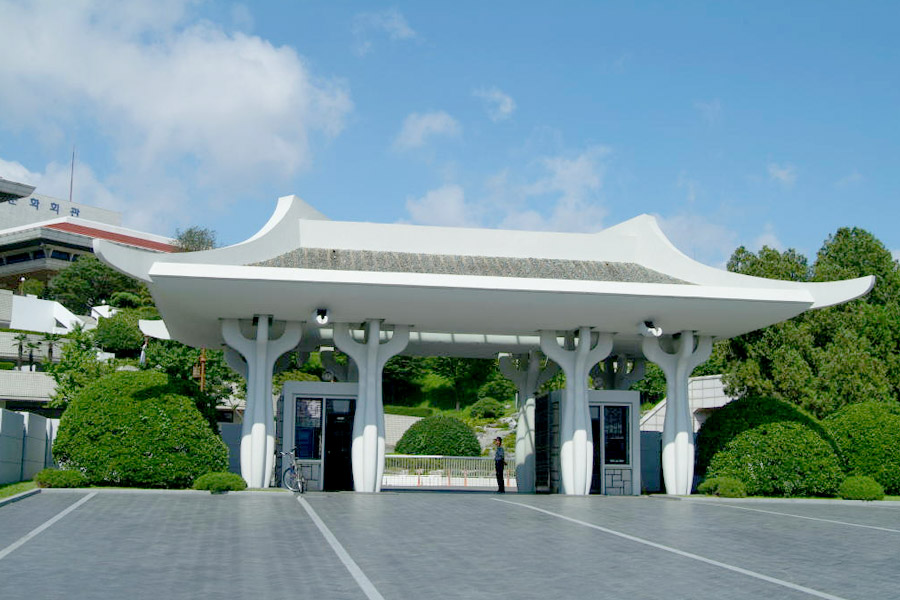
The cemetery’s directions identify bus 134 from the Busan Station area and bus 68 from Seomyeon. Confirm the current stop and direction in a local route planner, especially for the return journey. A taxi to the main entrance can help a party with limited walking stamina. Use the cemetery’s name, since the nearby UN Peace Memorial Hall is a separate destination. The main gate, designed by architect Kim Joong-up, is worth a measured look before entering; its open form marks a transition from the street to a deliberate pace.
Hours, admission and temporary changes
Admission is free. Normal hours are 09:00–17:00 from October through April and 09:00–18:00 from May through September, with the cemetery ordinarily open throughout the year. Closing time is the time to finish, not a sensible target for arrival. Arrive with enough margin to complete a modest route and leave calmly. An afternoon arrival around 16:00 in winter gives much less flexibility than the same time in summer, particularly if you hope to read displays as well as walk outside.
Grounds access and indoor access are separate questions. The notice for 30–31 October 2026 restricts the Memorabilia Hall and Memorabilia Hall II, so a visit on those dates should focus on outdoor memorials unless staff advise otherwise. Maintenance, exceptional weather and official events may also affect access. Before travelling specifically for a hall or ceremony, check the latest notice or contact the office on +82-51-625-0625. An older tourism listing cannot guarantee that every room is available on the day.
Read the layout before choosing a route
The main areas have different functions. The Symbolic Area presents flags and national memorials; the Main Grave Area holds many individual graves; the Green Area provides an open landscape containing major commemorative features. Find these names on the map. A visit becomes easier when you first identify the gate, the hall you hope to enter, the burial sections and the Wall of Remembrance, instead of repeatedly crossing the grounds to follow an unchecked list. Keeping that simple framework in mind also makes it easier to shorten a route when necessary.
For a first visit, begin at the entrance and an available introductory display, continue to the Symbolic Area and Main Grave Area, then move toward the Wall of Remembrance and wider green grounds. Adjust the sequence around a service or restricted path. This is a suggested connection between themes, not a marked guided tour or a promise that every shortcut is open. Where there is a choice between a longer path and a line through the grass or between graves, take the path.
Individual names in the Main Grave Area
The rows of graves give the cemetery its most personal scale. National sections include Australia, Canada, France, the Netherlands, Türkiye, the United Kingdom and the United States. Rather than attempting to read every marker, stop beside a few visible from a permitted path. A name, unit or date can interrupt the abstraction of casualty statistics. Read what the marker actually records; do not infer a person’s beliefs, family history or circumstances of death from nationality alone. The restraint of the landscape leaves room for careful attention.
A family researching a particular burial should prepare differently from a general visitor. Use the cemetery’s interred-person and grave-location search tools before travelling, note spelling variants and keep the location accessible. Staff can clarify the route, but a name on a commemorative wall does not automatically mean that the person has a grave here. Leave people making personal visits ample space and avoid including them in photographs without permission. These quiet rows are places of individual grief as well as a shared historical landscape.
Flags and national memorials
The flags express the international scope of the Korean War and the forms of support offered to Korea. They should not be read as a simple one-to-one map of burials. A country may be represented by a monument even when its history of repatriation or commemoration differs from that of a neighbouring section. Read the explanatory plaques alongside the visual arrangement. Each national memorial belongs to a larger story, but its own dedication, date and symbolism deserve attention. A few minutes spent reading can change how the surrounding garden is understood.
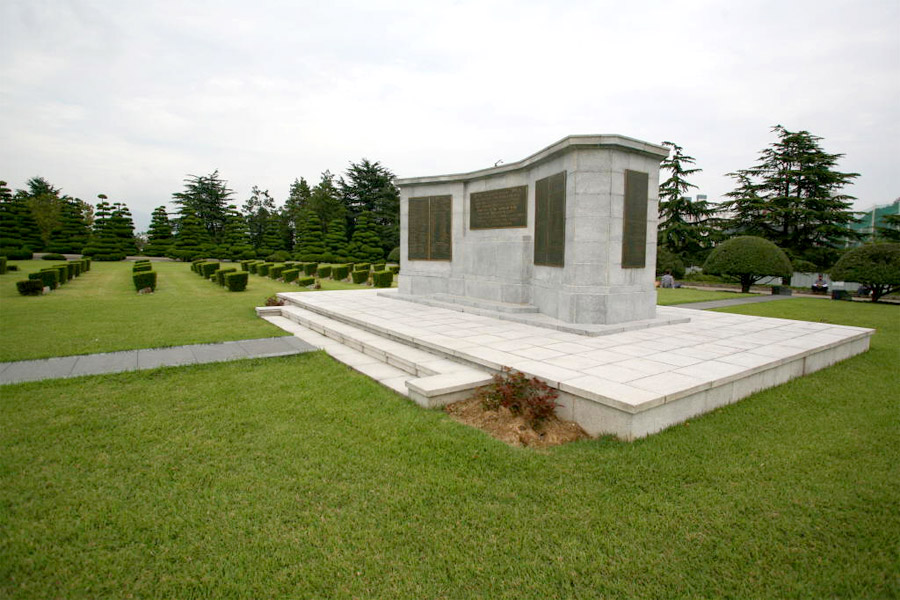
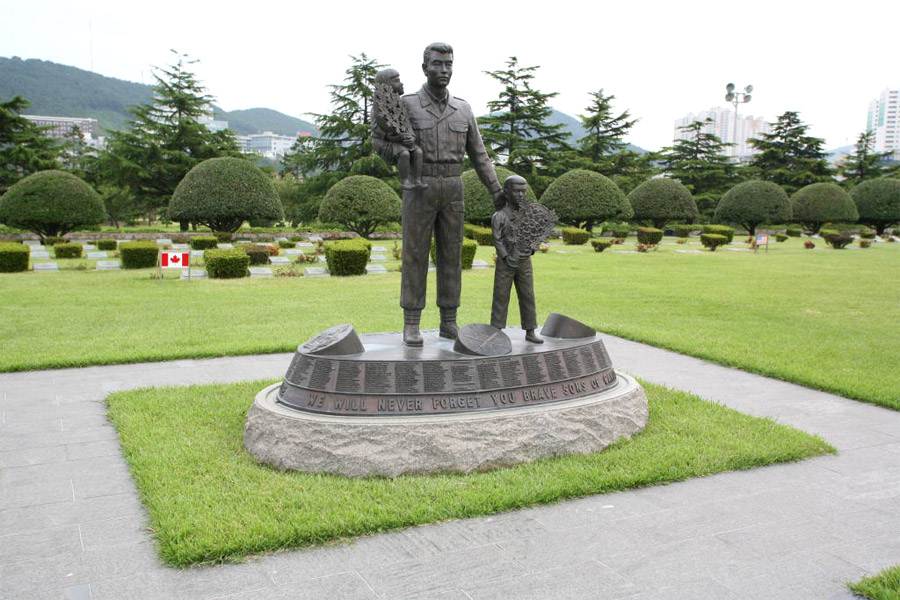
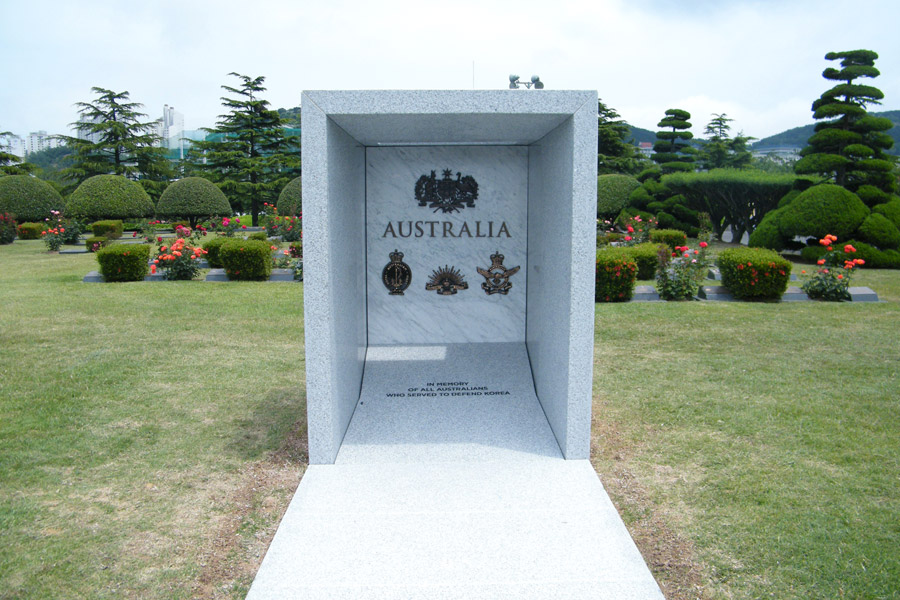
In the Main Grave Area, the Commonwealth Memorial commemorates missing personnel, while the Canadian memorial statue presents a soldier with children. The Australian memorial offers another way of relating a national contribution to the wider conflict. Compare their visual languages gently: a list of names, a figure and a compact monument invite different kinds of attention. There is no need to rank them or turn the visit into a collection. Choose two or three and spend enough time to understand what each remembers.
The Wall of Remembrance
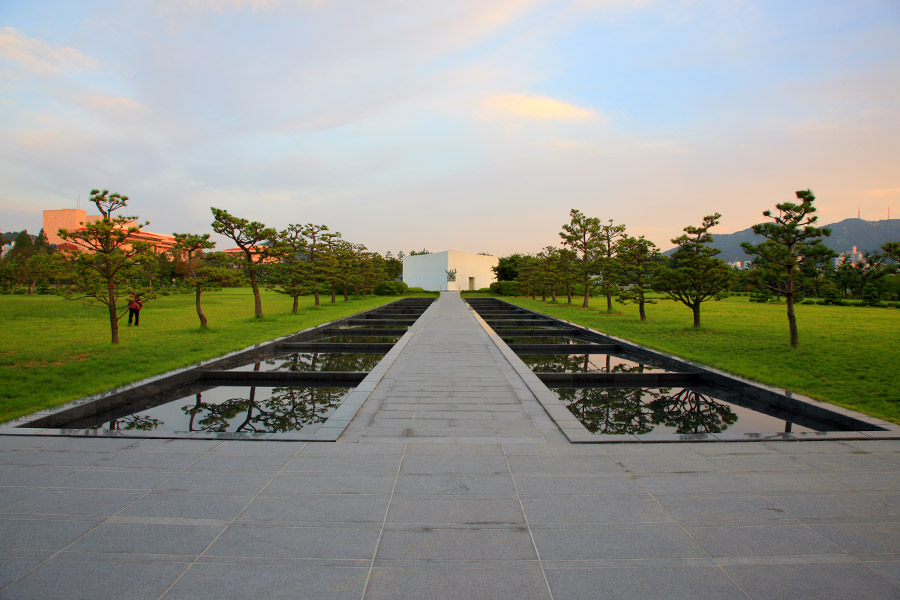
The Wall of Remembrance expands the scale from those interred here to the wider losses of UN forces during the Korean War. Its dark stone carries 40,896 names, including missing personnel. This number and the smaller burial total describe different groups; confusing them obscures the memorial’s purpose. Circular water and surrounding inscriptions give visitors a place to stand, read and consider the geographical reach of the conflict. The space can be approached as a place for stillness rather than as an exhibition to complete.
Names are arranged by country and alphabetically, and a diamond mark identifies people interred at the cemetery. If searching for someone, consult the wall-name search beforehand and keep the relevant spelling and section to hand. For other visitors, a small group of names is enough to begin. Attentive reading matters more than finishing the circuit. Water and polished surfaces may reflect light strongly; choose a comfortable position and avoid touching inscriptions or leaning over the water simply to improve a photograph.
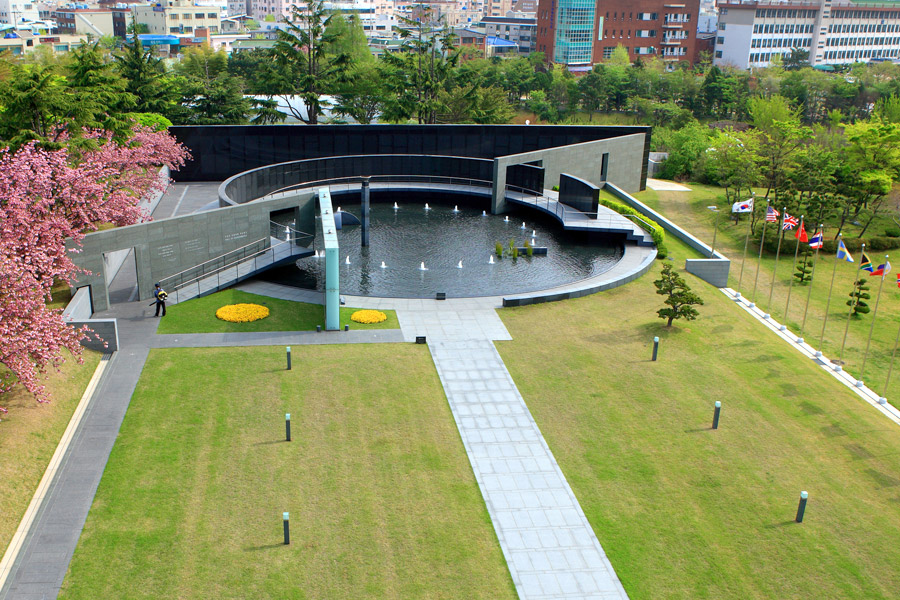
The monument, waterway and green grounds
The UN Forces Monument, dedicated in 1978, and the Unknown Soldiers’ Pathway provide a different rhythm after the densely inscribed wall. The pathway’s eleven water cascades commemorate unnamed fallen soldiers. The sound and pattern of water encourage a pause, but water features remain subject to operation and maintenance. A dry channel does not remove the memorial’s meaning, and visitors should not step into it to recreate a photograph. Read the surrounding plaques to connect the individual features with the site’s wider commemorative purpose.
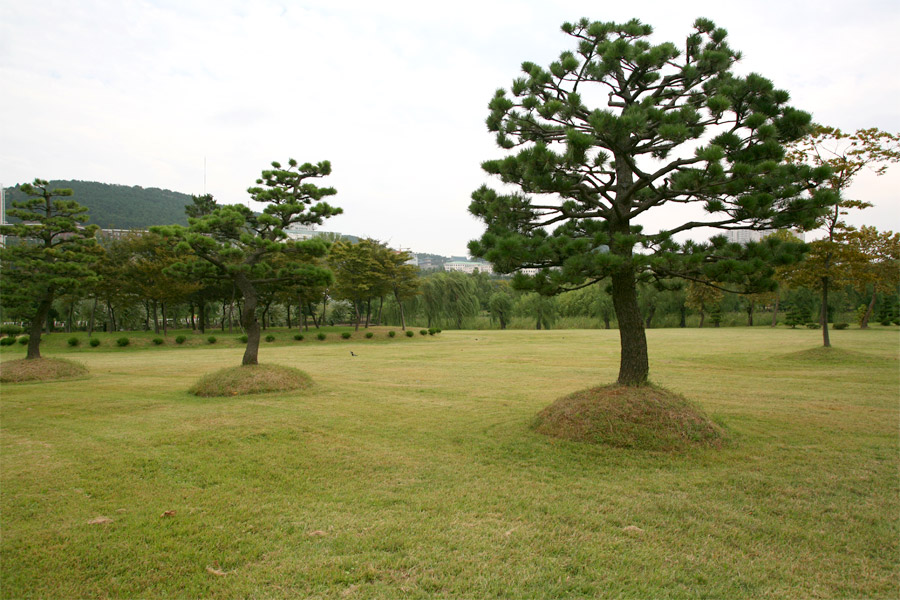
Open lawns, trees and further memorial elements make the Green Area a place to reflect while maintaining cemetery rules. Staff ask visitors whose main purpose is walking to favour roads in this lower area, away from burial plots. Families may find this useful after reading the markers. Stay on paths, leave plants undisturbed, and treat benches and wider views as opportunities to pause quietly. The landscape works best when its calm is shared with people who have come to mourn.
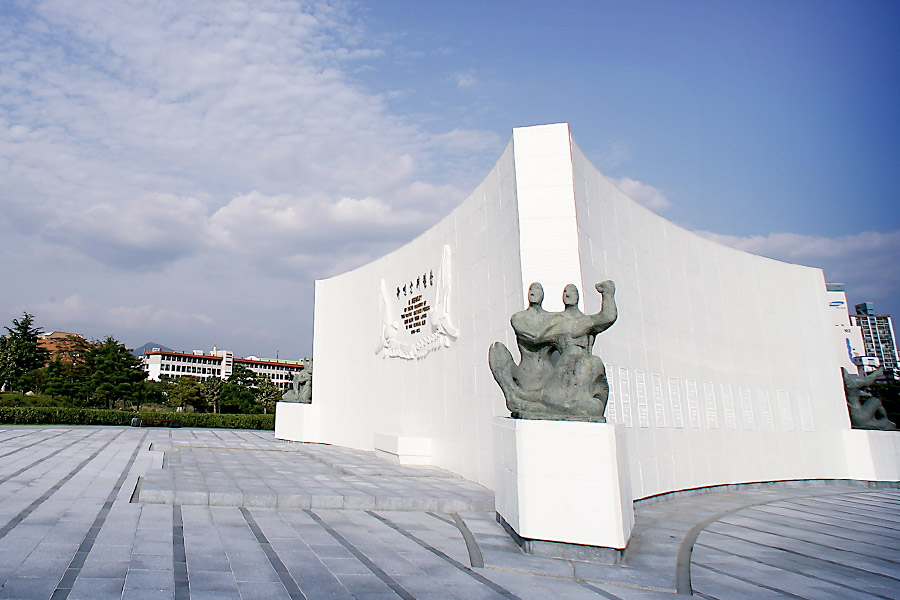
Indoor interpretation and architecture
The Memorial Service Hall, associated with architect Kim Joong-up and completed in 1964, offers a change from the open grounds through its geometric structure and stained glass. When access and screenings are available, a short documentary introduces the Korean War and cemetery history. Ask about the next showing and language rather than assuming a fixed start time or duration. Official descriptions have used different running times. Indoor interpretation is useful context, but the cemetery can still be understood through its outdoor spaces when a hall is unavailable.
The Memorabilia Hall and Memorabilia Hall II are distinct from the Service Hall. Read building names carefully when checking notices: a restriction on one building does not necessarily close the entire cemetery. In any exhibition, focus on a few objects or photographs and connect them to the names outside. Avoid assuming that displays represent every country in the same way. If a group is using a room, follow staff guidance and leave space for others instead of gathering around a doorway.
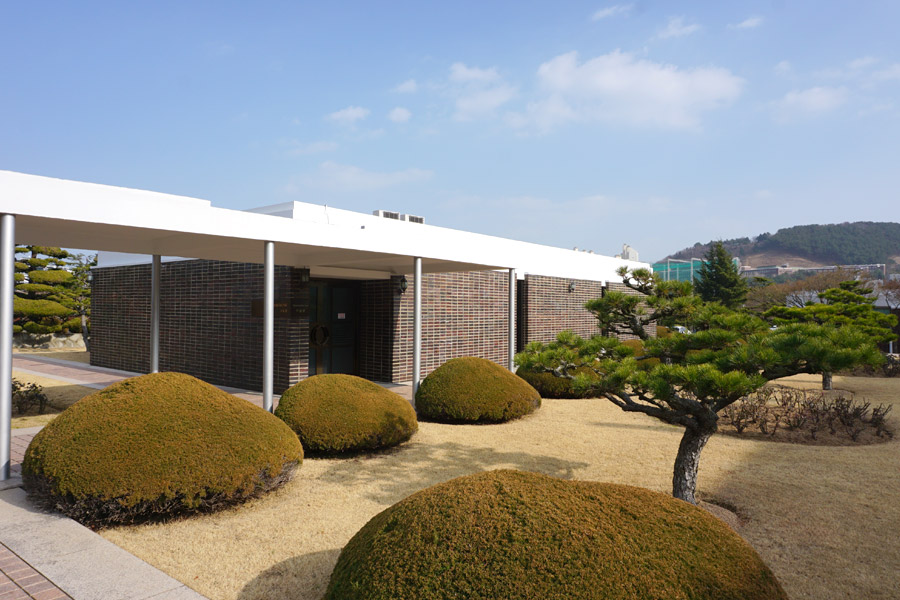
Ceremonies and the right way to watch
The cemetery currently advertises daily UN flag raising at 10:00 and lowering at 16:00. Arrive early enough to find the designated viewing area, and follow instructions if arrangements change. These are acts of remembrance: keep conversations and phone sounds low and stay outside the participants’ route. Watching from a respectful distance is enough. There is no obligation to move close to a guard or film the entire ceremony. If staff suspend or adjust a ceremony, shape the rest of the visit around the grounds.
Larger commemorations occur through the year, including occasions associated with UN Day and the November remembrance period. A major event may mean different access, more people and less freedom to move through an area. Do not build a tightly timed onward booking around an assumed ceremony length. If attendance at a specific event is the trip’s purpose, obtain its current visitor arrangements beforehand. For a quieter introduction, choose an ordinary day and let the individual graves and memorials guide the experience.
Dress, food and photography
Wear neat, comfortable clothes and suitable walking shoes. The rules exclude slippers or flip-flops, overly revealing clothes and close-fitting exercise outfits such as leggings or cycling wear. If combining the visit with a beach day or hike, bring suitable clothes. Running, exercise, smoking, pets and eating are not appropriate in the grounds. Food and drinks in disposable containers are restricted, so plan refreshments outside and ask staff about any essential accessibility or medical need. A little preparation avoids an uncomfortable discussion at the gate.
Media photography and video require consultation with management; commercial product or portrait shoots are prohibited, and drones require prior permission. A phone camera does not make an intrusive setup acceptable. Do not stand on grass, move flowers, pose on monuments or block a path for a picture. Avoid photographing mourners at close range, and put the camera away when it might distract from a service. A few thoughtful landscape views usually communicate more than an uninterrupted record of everything. Personal photography should remain secondary to remembrance.
Comfort, access and visiting with children
Most of the visit is outdoors. In summer, favour a cooler part of the day and plan refreshments outside; in rain, take care on wet paths and keep umbrellas clear of other visitors. Winter calls for an earlier start before the 17:00 closing. Accessible visitor facilities are available, but the practical route depends on entrances and paths open that day. Ask at the gate about step-free access, toilets and wheelchair availability rather than assuming that every connection is equally easy. A shorter route may be the most comfortable option.
Children can engage through a few clear observations: a flag, a name, a remembered person and the reason adults speak softly. Explain rules before entry and shorten the route if attention fades. Do not make finding graves a game or ask children to perform sadness for photographs. A quiet conversation after leaving may help more than a long explanation beside a family’s grave. Visitors with limited stamina can similarly choose one burial section and one major memorial without feeling the visit is incomplete.
A calm half-day in Nam-gu
Busan Museum, the UN Sculpture Park, UN Peace Park and UN Peace Memorial Hall are nearby possibilities, but they are separate places with separate purposes and operating arrangements. The cemetery can anchor a thoughtful half-day: arrive in the morning, spend unhurried time among the memorials, take lunch outside, then choose one additional museum or park. Do not assume that a museum shares the cemetery’s year-round opening pattern, or that a route between map pins is entirely level and sheltered. Check the next destination before committing to the walk.
If time is tight, keep the cemetery as a complete visit of its own. Return to the gate with a margin, confirm the bus direction or walk back to Daeyeon, and let the change back to the city happen gradually. What makes the visit memorable is rarely the number of monuments covered. It is the relationship between a carefully read name, the international history behind it and the living city beyond the walls. Leaving time for that connection is the most useful preparation.
Reviews 1
Understanding remembrance
Public visitor review summary
Portraits stirred my respect; a French-language film helped me understand the war.
A little closer to Korea.
Thank you for reading.