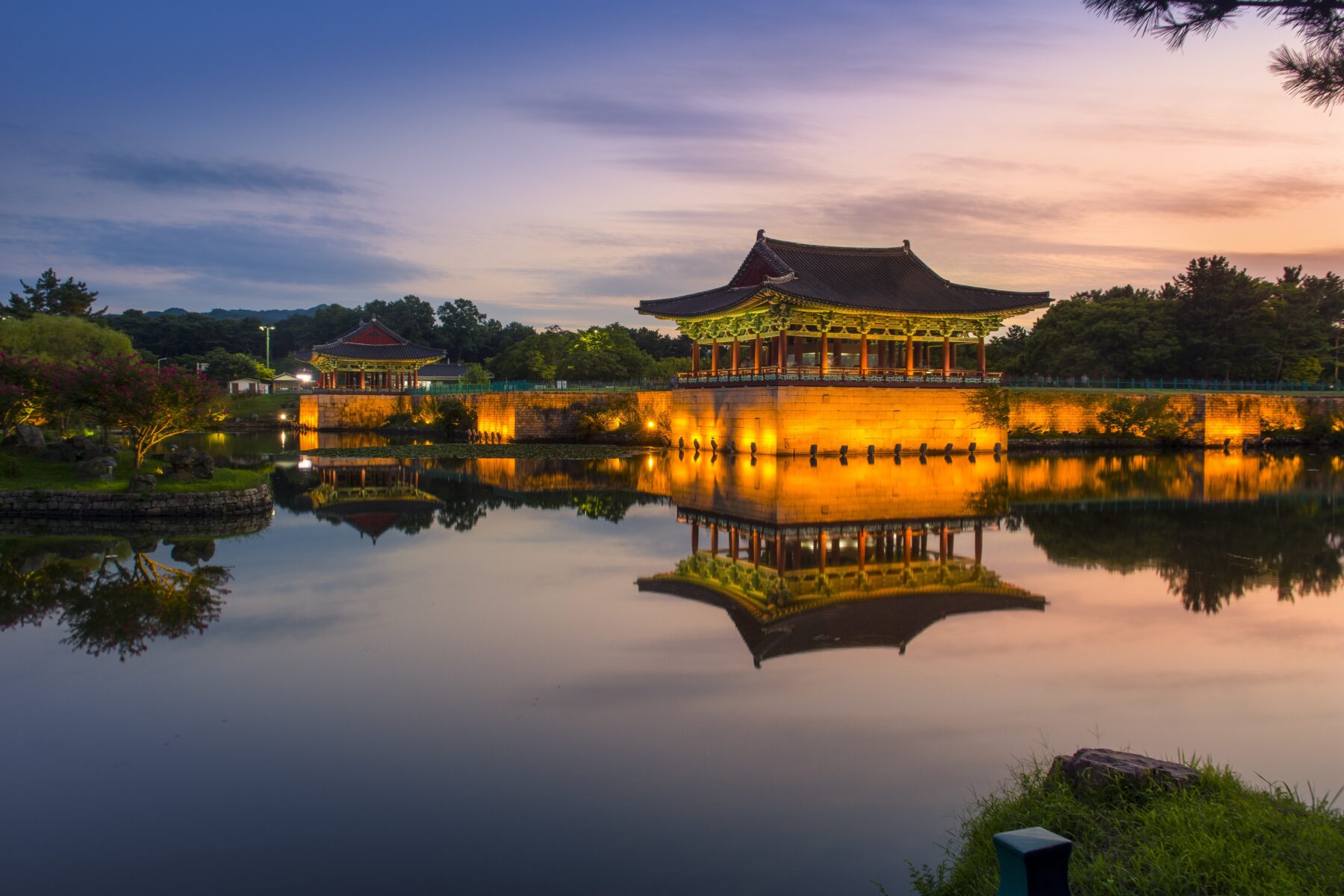
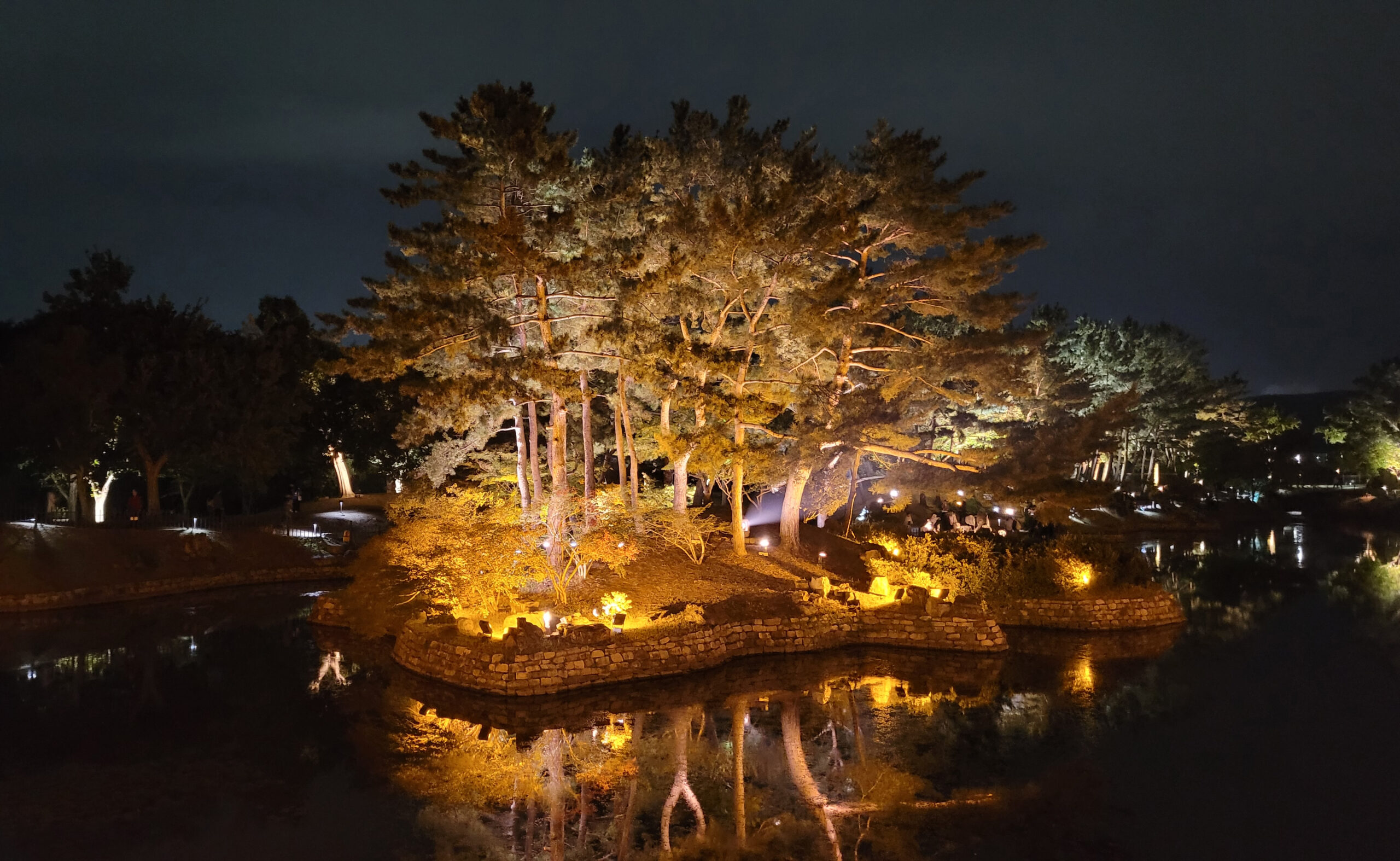
The photograph is easy to recognise: warm light under tiled roofs, a dark pond, and a second palace floating in the reflection. Donggung Palace and Wolji Pond can deliver that moment, but the visit becomes more interesting when you arrive before it. In daylight you can read the shoreline and the gaps where buildings once stood. As evening settles, the same place becomes a carefully framed landscape. Give yourself time for both.
This is a good Gyeongju stop for friends travelling on a modest admission budget, couples who enjoy an evening walk, or anyone who likes architecture without needing a full day inside a museum. It is less satisfying if you expect a vast, fully furnished palace. The surviving site and reconstructed pavilions ask you to imagine what is missing. The lights are part of today’s presentation, not a surviving scene from Silla.
What you are actually looking at
Gyeongju was the capital of the Silla kingdom. The city’s account dates the creation of Wolji to 674, during King Munmu’s reign, and Donggung to 679. The eastern palace was associated with royal princes, while its Imhaejeon area hosted entertainment, meetings and receptions. That social purpose is helpful to remember: the garden was meant to impress people and shape how they moved and looked, not simply provide a pretty patch of water.
Look at the pond’s outline before focusing on the roof decorations. Its southern and western edges are straighter, while the northeastern bank curves. The city explains that the irregular shoreline prevents the whole pond being seen at once. Try walking a little farther whenever a view seems complete. A tree or bend interrupts one composition, and another opens. The apparent size changes because the landscape withholds its farthest edges.
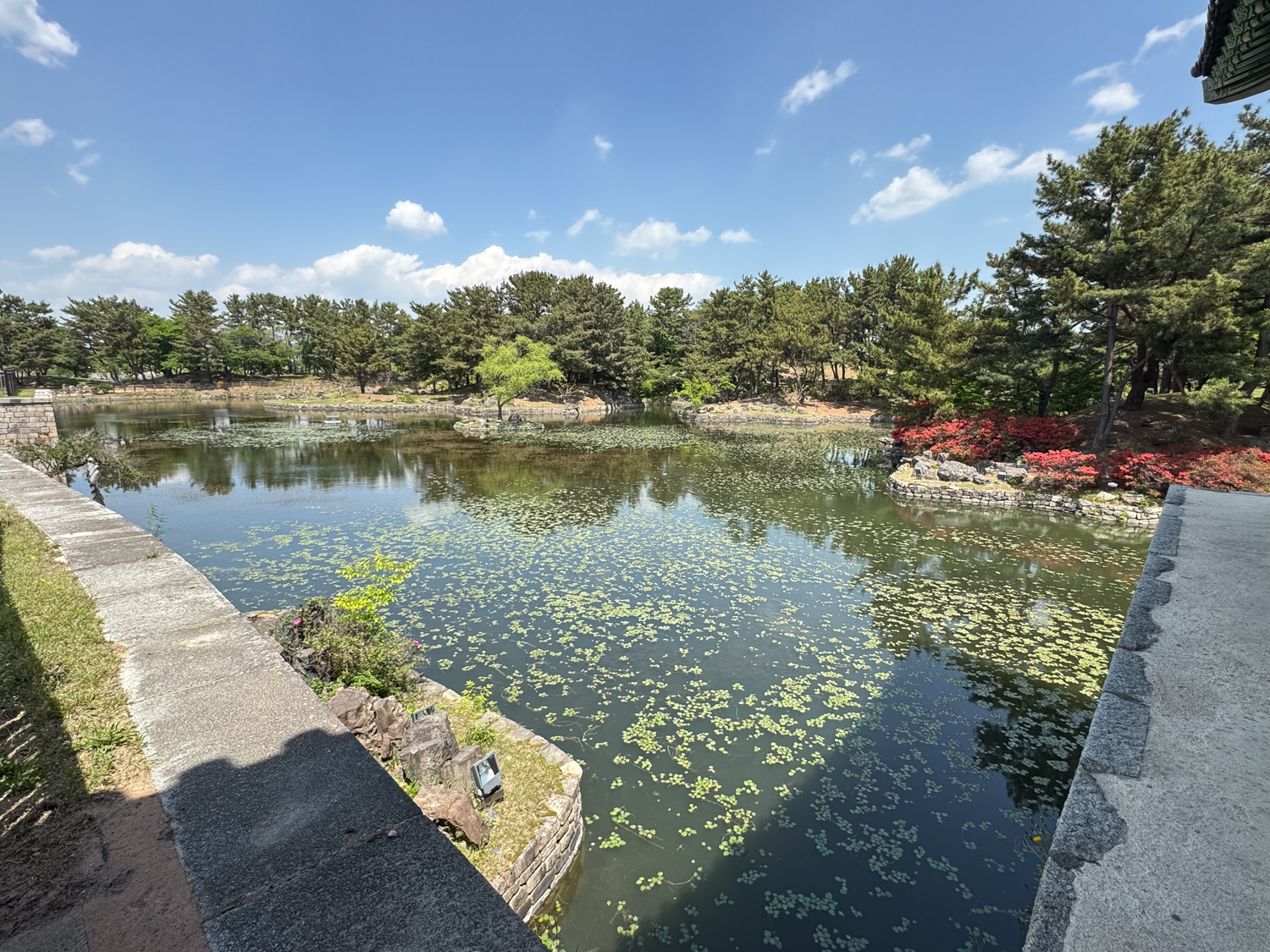
The place was long known as Anapji, the pond of geese and ducks. Archaeological finds helped recover the Silla name Wolji, and the site officially regained the name Donggung and Wolji in 2011. Older maps, photographs and reviews may therefore say Anapji. They usually refer to this same attraction, not a second pond you need to add to the itinerary. Save 동궁과 월지 in your map app to keep the search straightforward.
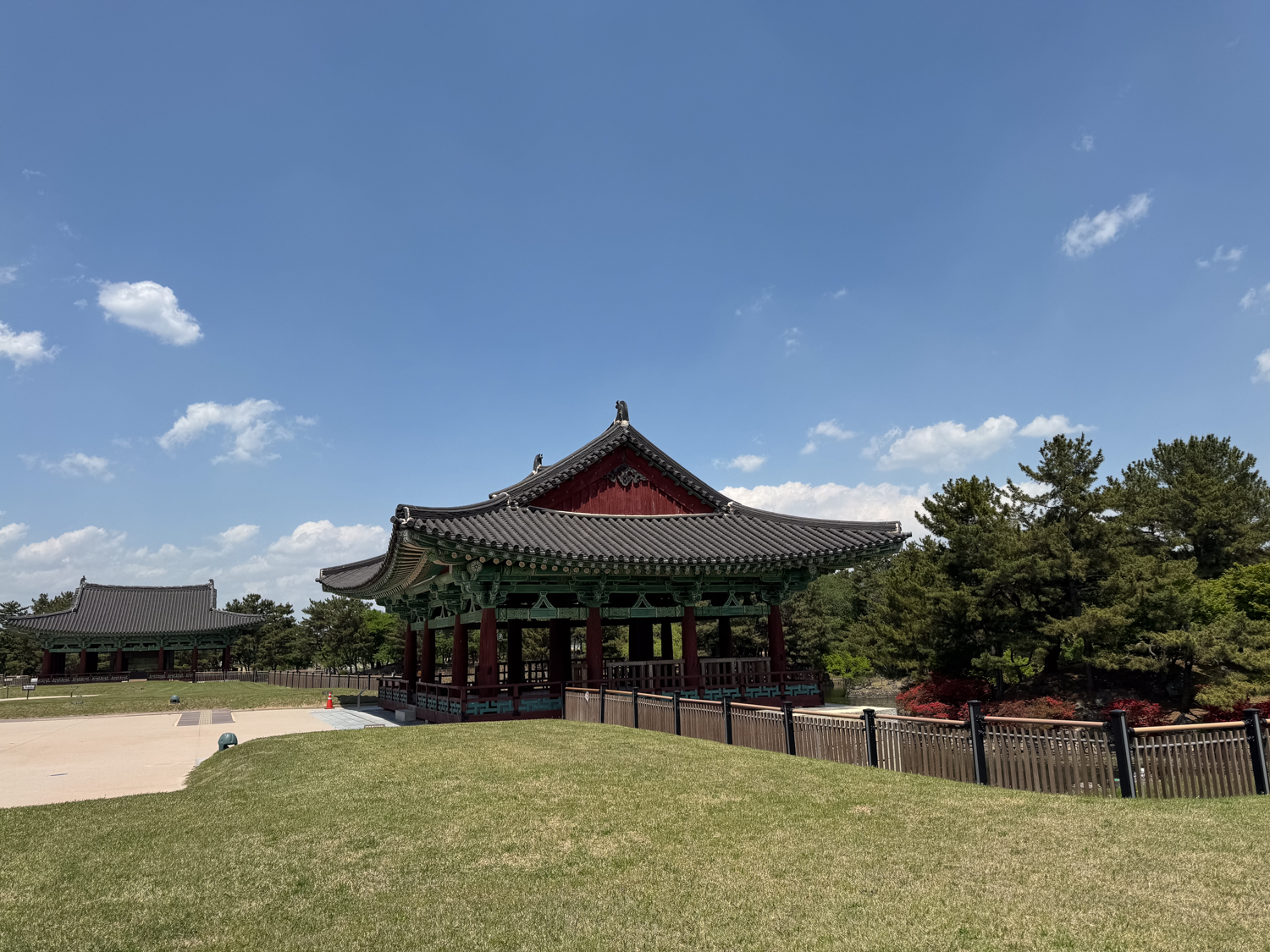
Excavation and restoration matter here. Investigations in the 1970s revealed the pond, building remains and many objects; archaeological work has continued in the wider palace area. The pavilions visitors photograph are reconstructed, so do not read every visible timber as seventh-century material. Notice the building footprints and open spaces as well as the finished structures. They make the difference between a beautiful night view and a site where evidence is still being interpreted.
Choose an evening, then protect the hour around dusk
For a first visit, plan to enter roughly 30 to 45 minutes before local sunset and allow about 60 to 90 minutes inside. These are editorial planning allowances, not an official tour duration or a promised lighting schedule. You will have time to understand the layout, walk along the water and stay as the sky darkens. Check the day’s sunset separately; an arrival time that works in June can be far too late in November.
The blue-hour photograph and the deep-night photograph are different choices. A little light left in the sky separates roofs from the background and shows more of the garden. Later, the illuminated architecture becomes a brighter focal point against the darkness. Neither requires you to occupy one spot all evening. Take an early picture, continue the walk, and return only if the route and crowd allow it. Moving often gives you a more distinctive view.
Crowds are the main compromise. This is one of Gyeongju’s well-known night stops, and tour groups may arrive together. A quiet-looking photograph should not be treated as a promise of solitude. If the first viewpoint is busy, keep to the marked path and explore another angle instead of pushing toward the edge. Give people space to finish a picture, then take your turn. Keep tripods and bags out of the walking line and follow any local restrictions.
Still water helps produce a clear reflection, but wind, rain and movement change the result. A phone’s night mode can brighten the scene while exaggerating lights or blurring a moving friend. Try a steady two-handed hold, a slightly darker exposure and a frame that includes the waterline. For a portrait, use the existing light rather than a flash aimed across the pond. You can make a good memory without reproducing a long-exposure publicity image.
Getting to the pond is not the same as getting to Gyeongju
The address is 102 Wonhwa-ro, Gyeongju. There is no urban subway route to the entrance. If you arrive by KTX, Gyeongju Station is outside the historic centre; do not leave only a few minutes between stepping off the train and reaching the pond. Save the station and your accommodation separately, then check the actual bus or taxi journey. Travelling light makes an evening stop much easier than carrying a suitcase around the garden.
City transport information lists bus 710 as a connection from the KTX station toward the central sightseeing area, while buses 10 and 11 serve the historic-city circuit in opposite directions. Routes, boarding positions and intervals need a live check: enter 동궁과월지 as the destination and confirm the direction shown for your departure point. Use the city bus information service or a Korean map app. Do not board only because the bus number looks familiar.
Arriving at Gyeongju’s intercity or express bus terminal gives you a different starting point from arriving at the railway station. Compare the whole journey, including the final local leg, rather than the headline rail time alone. If several friends share a taxi, the saved transfer time may be worth more than squeezing in another bus. Before entering the pond, check how you will return, especially when a reserved train or the last useful bus is involved.
A small route that leaves room for dinner
One manageable afternoon starts with Gyeongju National Museum, continues toward Donggung and Wolji for dusk, and ends with dinner back in the central streets. The museum gives objects from the excavations a setting, so the empty building plots outside feel less abstract. Check its own opening and last-entry notices: the pond’s late closing does not mean the museum stays open equally late. If you are already tired, choose one museum section instead of treating every gallery as compulsory.
Another option is a late-afternoon walk around the Cheomseongdae area, followed by the pond and then a meal. Follow mapped pedestrian crossings and the current walking route rather than cutting across protected grass or archaeological ground. The landmarks are close enough to combine, but they are separate sites with roads and open spaces between them. Allow extra time when taking photographs or travelling with someone who walks more slowly.
Hwangnidan-gil is useful for cafés, food and a longer break, but a late lunch queue can quietly consume the best evening light. Eat earlier if the pond is the priority, or choose a simple dinner afterwards. A café with a famous façade is not automatically the most useful stop for your route. Check the menu, serving size and last order before sitting down, and ask directly about ingredients if you have dietary restrictions.
Woljeonggyo Bridge is another appealing night view, but adding it is optional. The bridge and the pond offer different compositions; you do not need to prove that you have seen every illuminated landmark. If you have already walked all day, keep the pond as the final visit. If you feel fresh, check the route and allow a proper walk between them. Leave enough time for the return journey rather than letting one more photograph decide your evening.
The useful details, without turning the visit into a checklist
As checked on November 5, 2026, Gyeongju City and the Korea Tourism Organization list opening from 09:00 to 22:00, with ticket sales and admission ending at 21:30, and no regular closing day. Standard individual admission is 3,000 won for adults, 2,000 won for teenagers and 1,000 won for children. Confirm any concession you intend to use at the ticket office. Arrive comfortably before the cutoff; it is a final entry limit, not a recommended starting time.
For current visitor enquiries, the published number is +82-54-750-8655. Save the Korean attraction name and your accommodation address before dark. Comfortable shoes matter more than a costume or a complicated camera bag, and a warm layer is useful for a slow November walk beside water. Bring enough phone battery for directions afterwards. Check access arrangements with the operator if steps, uneven surfaces or a particular mobility need affect your plans.
A wet evening does not automatically ruin the visit, but slippery surfaces and umbrellas can make narrow viewing points awkward. Protect the camera and let people pass before stopping. In warm weather, a little water and insect protection can be more useful than another lens. Use designated paths, do not climb onto stonework for a cleaner composition, and take litter out with you. These small choices help keep a busy heritage site pleasant for everyone.
An overnight stay in Gyeongju makes this visit easier to enjoy because the evening no longer has to compete with a long journey home. A day trip can still work if you have checked the return carefully and deliberately limited the daytime programme. Choose the version that suits your energy and budget. A museum, a meal and an unhurried pond walk can be a fuller experience than a list of six places seen through a bus window.
The best reason to come is the change in how you see the place. At first, the restored roofs may be the whole attraction. After walking the shoreline, noticing the missing buildings and watching the light move, the water starts to hold the visit together. Put the phone away for a few minutes before leaving. You may remember the shape of that evening more clearly than the sharpest reflection in your camera roll.
Reviews 6
Elegant, but busier than I expected
Public review · edited
Donggung and Wolji was my second-favourite stop, and it was unexpectedly the busiest with tourists. Compared with the showier night view at Woljeonggyo, it felt restrained and elegant to me.
I personally preferred the bridge’s night scenery, but if I had to recommend only one of the two, I would choose Donggung and Wolji because there was more to explore.
BigBigslection · Reddit
A memorable first evening in town
Public review · edited
Gyeongju became one of the most memorable parts of our trip. We stayed in a hanok-style place in the centre, checked in, and went out to Donggung and Wolji that evening. The lighting was beautiful.
On the walk back we saw Cheomseongdae and the old tombs illuminated too. I liked Gyeongju’s mixture of newer, trendy places and an older, slower atmosphere.
PopcornAndZeroCoke · Reddit
Beautiful light, with a crowd to match
Public review · edited
The warm lights on the buildings and their reflections were wonderful, but the evening felt busy as well as magical. There were people photographing everything, and the crowd slowed the walk.
I could move from one building to the next fairly easily, and people generally helped the flow along. For me the ticket was good value. Weather changes the experience, but I would choose a night visit.
goodguyjas · Tripadvisor
The walk mattered more than a quick picture
Public review · edited
I enjoyed slowing down on the path around the pond, stopping for pictures or sitting on a bench to watch the water. Music came from speakers hidden among the bushes; it felt a little odd, but pleasant too.
The path was quiet when I visited. For me, only taking a few pavilion photos would miss the point. Walking around the water was a welcome pause from rushing between sights.
spendley3 · Tripadvisor
I would fit it into a route, not make a detour
Public review · edited
I came as part of an organised tour. The night view was beautiful, but it was very crowded with tour groups. I would stop if it fitted the route; I would not make a special detour just for this. For me, the photographs already showed most of what I came to see.
Marbles20 · Tripadvisor
Busy, yet calm enough to linger
Public review · edited
The night visit was one of my trip’s highlights. When the lights came on, the pavilions and their reflections changed the whole scene. It reminded me of a historical drama.
There were other visitors, but it did not feel chaotic to me. People were strolling, stopping for photos and looking at the water. I enjoyed taking my time because each position gave a different view of the reflections.
Nana Sim · Trip.com
A little closer to Korea.
Thank you for reading.