A small band with a clearly drawn pattern
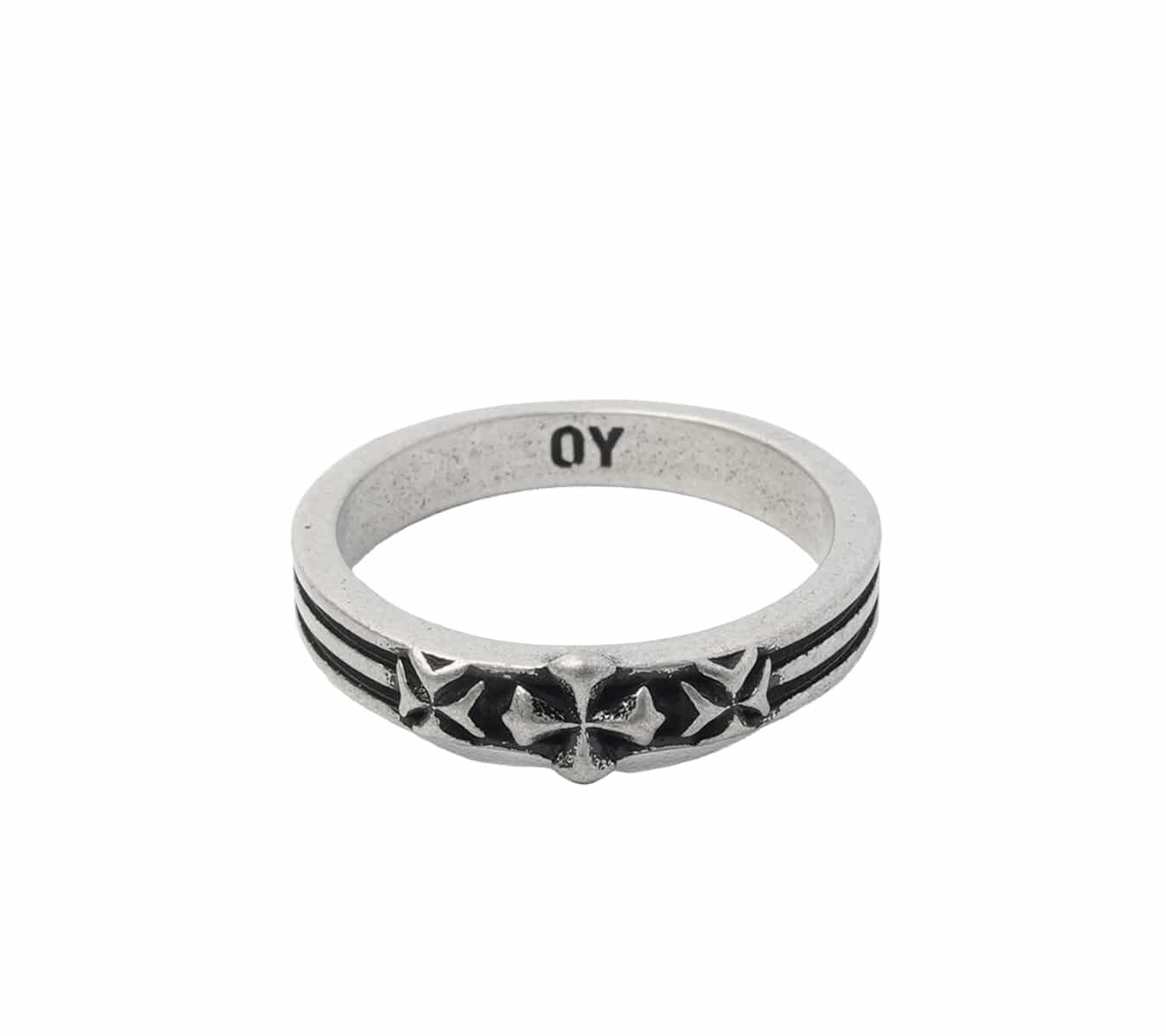
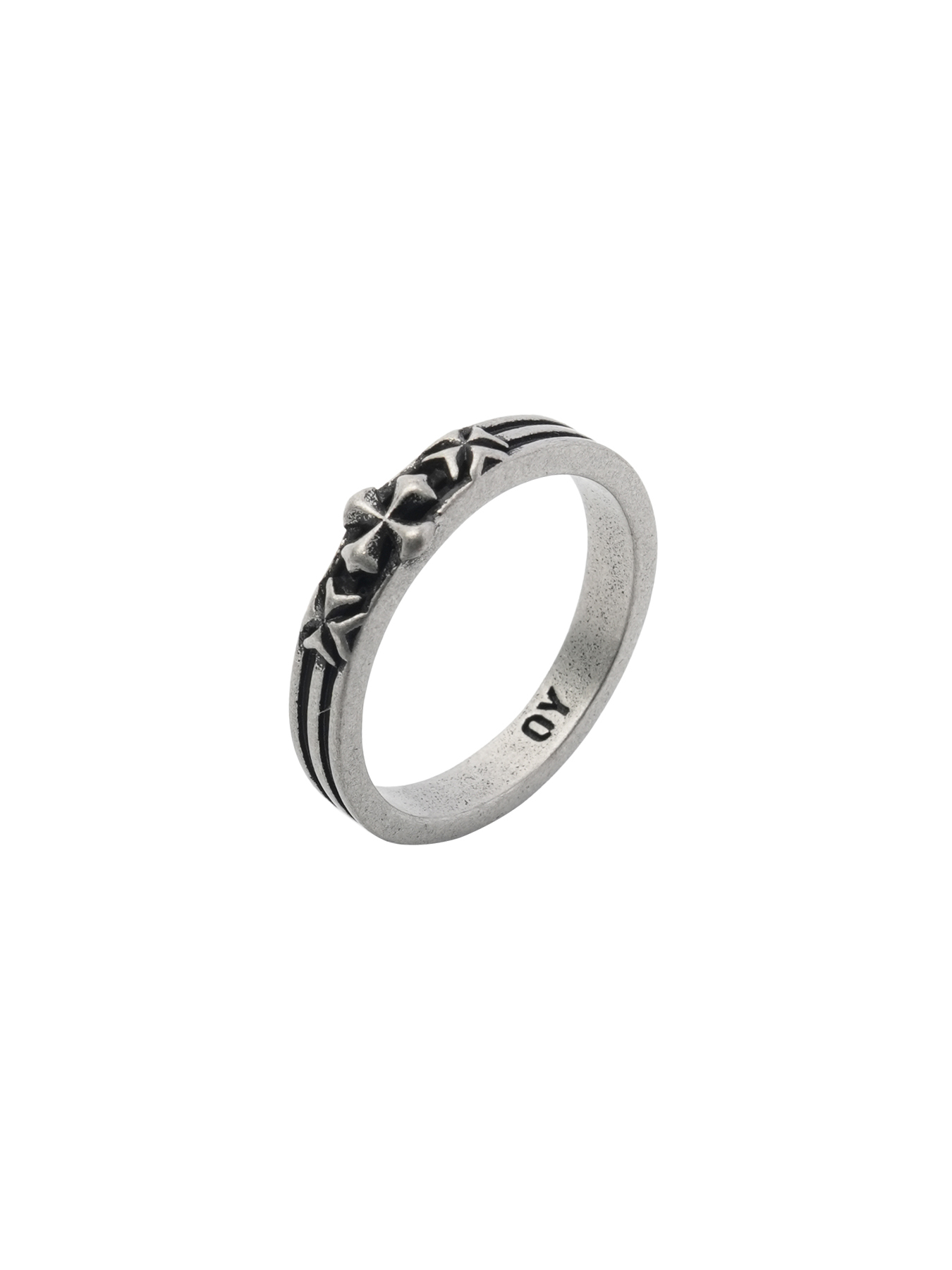
OPENYARD(OY)’s Multi Cross Ring uses contrast to make a relatively compact accessory noticeable. Raised cross motifs sit against dark recessed areas, while parallel lines continue around the sides of the band. In the front-facing product image, a larger central cross is flanked by smaller motifs; the angled view shows how the decoration rises above the surrounding surface. The effect is more detailed than a plain band, but the wearing photograph shows a restrained strip across the finger rather than a very wide cuff-like ring. No band-width measurement is published, so that comparison remains visual.
The finish has a muted silver-coloured appearance with darker areas that emphasize the relief. It is not the uniformly reflective surface of a simple polished ring. An OY mark is visible inside, keeping the brand reference away from the main outward-facing pattern. The product is identified as MULTI CROSS RING – SILVER, with the retailer code OYBEF1AC022SI. This guide examines the published information and photographs rather than claiming a personal wear test. Its purpose is to explain what the ring actually offers and how to decide whether its proportions and available sizes suit your plans.
Silver names the colour, brass names the material
The material entry is BRASS, and the manufacturing origin is the Republic of Korea. Silver is the colour option, not a declaration that the ring is sterling silver or solid silver. These statements should remain separate when comparing it with other jewellery. The official brand shop also lists brass and uses the base product code OYBEF1AC022. Matching the full product name and code helps avoid confusing this design with the brand’s other cross-themed rings, which may have different patterns, widths or size ranges.
The exact surface treatment is not specified in the information checked. That means the silver-coloured appearance does not establish a particular plating metal, coating thickness or protective layer. It also does not establish nickel-free construction, an allergy guarantee or permanent resistance to colour change. If a known material restriction determines what jewellery you can wear, ask for the relevant composition and finish information before buying. A colour name cannot answer that question. The same uncertainty matters for care: products intended for solid silver should not automatically be used on a brass ring with an unspecified finish.
The official size table resolves the unit question
The official OPENYARD Size & Fit table explicitly uses millimetres. Size S is listed with a finger circumference of 56.5mm and an inner diameter of 18mm. Size M is listed with a finger circumference of 59.7mm and an inner diameter of 19mm. These are the useful product-specific dimensions for comparison. The two options differ by 1mm in the stated inner diameter and 3.2mm in the listed circumference. Neither letter is a universal ring size shared by every brand, so ordering the same letter as another ring is not a reliable shortcut.
The retailer’s text presents the same numbers under a SIZE(CM) heading, which can cause confusion. The brand’s own table labels them MM and names both measurements, providing a clearer basis than guessing a conversion from the retailer’s heading. Generic centimetre-based sizing language elsewhere on the page should not be turned into a large tolerance for this ring. Keep the specific millimetre table as the reference, and ask the seller if the physical item or a later listing differs. No US, UK or other national ring-size equivalent is claimed here.
Compare the inside opening, not the outside edge
A comfortable ring worn on the intended finger is a useful starting point. If comparing diameter, measure across the inside opening at its widest straight line, excluding the metal on both sides. An outside-to-outside measurement would include the band and cannot be compared directly with the published 18mm or 19mm inner diameter. A ring with an irregular or distorted opening is also a poor measuring reference. Take time to identify the actual inner edge, especially if the existing ring has a bevel or a rounded inner profile.
A jeweller’s sizing tool or an in-person fitting can make the decision clearer when the result falls between the two options. A paper strip or an on-screen circle can introduce error through tension, thickness or display scaling, so a single casual measurement should not become a guarantee. Compare both the intended finger and the hand on which you plan to wear it. If neither S nor M matches a comfortable fit, it is reasonable to choose another model rather than assume this ring can be opened, squeezed or professionally resized; those services and adjustment features are not established.
The knuckle and the base of the finger both matter
A ring needs to pass the knuckle as well as sit comfortably at the base of the finger. Those two locations are not necessarily the same width, and a fit that feels secure in one position may be awkward in the other. Try the ring without forcing it and notice whether removal is manageable as well as whether it stays in place. A photograph of someone else’s hand cannot answer this question because the model’s finger measurements and selected ring size are not identified. The wearing image is a proportion reference, not a personal sizing chart.
The chosen finger also changes the visual result. On an index finger, the cross detail is visible when the hand rests beside clothing; on another finger, surrounding fingers may partially hide the sides. Neither placement is prescribed by the product. Decide where you would actually wear it before selecting a size, rather than buying a preferred letter and hoping to find a finger later. If you are choosing a gift, a confirmed size for the intended finger and a workable exchange arrangement are more dependable than estimating from a photograph or from general hand size.
Relief should be assessed in movement
The raised motifs create the ring’s character, but they also give the surface a different profile from a flat band. When trying it, gently open and close your hand and notice contact with neighbouring fingers. The central ornament, outer edges and side lines may become more noticeable during movement than when the hand is still. This is a reason to check the actual fit, not a claim that the design is uncomfortable. The published material does not provide a weight figure, so the solid-looking product image cannot prove heaviness or lightness.
Think about the ordinary tasks you perform with the chosen hand. Gripping a bag handle, holding a phone and slipping a hand into a pocket place the ring near different surfaces. A textured piece should not need to be forced past tight seams or pressed against delicate fabric. If you prefer jewellery that is almost imperceptible during hand movement, compare the raised profile carefully with a simpler band. If the pattern is the main attraction, make sure that it remains enjoyable in actual use rather than judging only the attractive front-facing photograph.
Wearing it alone gives the crosses room
The simplest styling approach is one Multi Cross Ring on an otherwise uncluttered hand. Its darker grooves already provide contrast within a small area, so it does not need several competing rings to become visible. The parallel side lines keep the band readable even when the central ornament is not facing directly towards the viewer. A plain cuff or sleeve makes that graphic detail easier to see. This can work with everyday denim and a knit as readily as with an all-black outfit; the ring’s motif does not require a complete themed wardrobe.
Notice the amount of visible skin around the band as well as the ring itself. Leaving neighbouring fingers free gives the relief a clear outline, while a watch can provide a separate point of metal farther up the hand. If the watch is already large or highly decorated, the ring can be the smaller supporting detail. Matching every metal tone exactly is not necessary, but repeating one finish or keeping the rest simple can make the combination more coherent. The goal is a clear relationship between accessories, rather than adding pieces simply because the ring has a strong motif.
Layering works best when scale and spacing differ
For a layered look, a much narrower plain band can contrast with the crosses without hiding them. Wearing the second ring on another finger often leaves more room for the pattern than placing several textured rings directly together. Pay attention to contact between pieces: decorative relief and hard edges can rub against a neighbouring ring. The visual suggestion of layering is not a guarantee that every combination will be comfortable or leave both finishes unchanged. Try the arrangement gently and assess it while moving your hand.
Avoid assuming that two rings with the same letter size will fit identically, especially if one is wider or has a different inner profile. Likewise, adding another band to the same finger changes how the pair occupies space. Start with the Multi Cross Ring as the focal piece and introduce one simpler element at a time. A chain bracelet, another cross motif and a patterned watch strap can all compete for attention; you do not need to use all of them at once to make the ring feel intentional.
The denim-and-knit photograph offers a useful styling cue
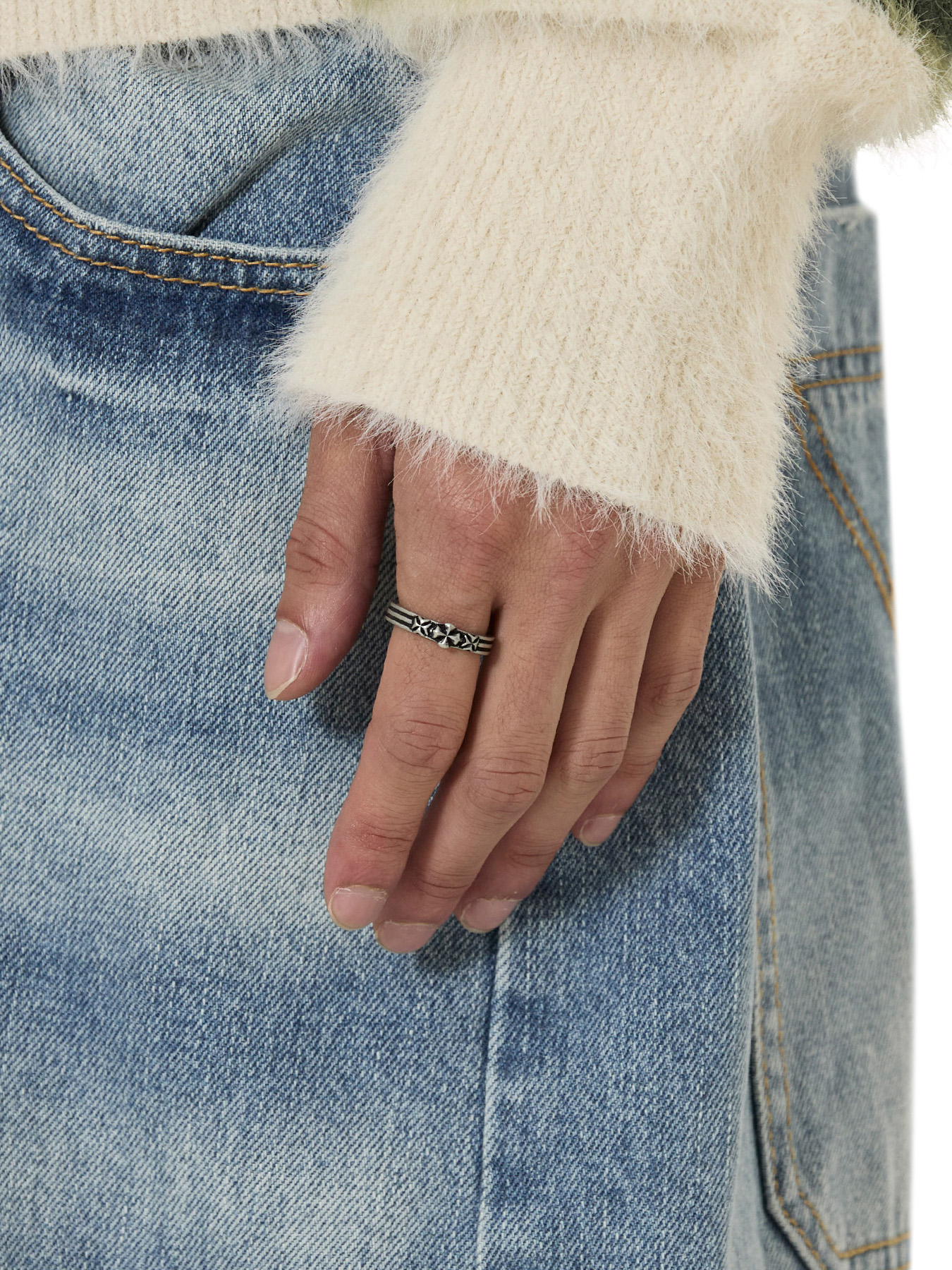
The wearing photograph places the ring beside blue denim and a light, fuzzy knit sleeve. That combination makes the silver-coloured relief visible against both a cool fabric and a soft pale texture. It is a practical example of how a cross motif can work outside a strictly dark or rock-inspired outfit. A cream cardigan, faded jeans and a simple top can leave the hand detail as the sharper element. The picture shows the relationship between materials and colours, not proof of the exact garments included with the purchase.
A textured knit also suggests a useful handling consideration. Raised jewellery can come close to loose fibres when sleeves slide over the hand, so move carefully rather than dragging the ornament through a tight cuff. This is not evidence that this particular ring has caused snagging; it is a sensible way to handle relief beside delicate fabric. For a cleaner visual result, let the cuff finish slightly above the ring instead of covering half the motif. The accessory then remains readable without requiring an exaggerated pose or a stack of additional jewellery.
A more restrained outfit can keep the motif visible
With a white shirt, charcoal trousers or a navy jacket, the ring can function as a small interruption in an otherwise orderly outfit. Its dark grooves relate easily to dark clothing, while the lighter raised surfaces keep it from disappearing entirely. The contrast is different from adding a bright gemstone or a large coloured accessory. If the shirt has prominent buttons, a patterned cuff or strong contrast stitching, leave enough visual space around the hand so the cross detail does not have to compete with every nearby feature.
A more decorative ring may not suit every dress code or personal preference, and the product does not require a particular occasion. Consider whether the motif fits the setting you actually intend to wear it in. For a simple evening outfit, one ring may be enough; for casual layered clothing, a restrained bracelet can connect the hand to the rest of the look. These are styling possibilities rather than claims about what a wearer must express through a cross. The design can be assessed as a visible shape without inventing a personal story or belief for the buyer.
Inspect the pattern and surface before regular use
On arrival, compare the item with the selected size and the product images under ordinary light. The dark recesses are part of the visible design, so they should not automatically be mistaken for dirt that must be removed. Look separately at the raised edges, the interior and the continuity of the side lines. A muted, slightly textured appearance is different from a new visible defect, but photographs alone cannot settle every disputed mark. If something looks inconsistent, document it clearly and ask the seller before attempting to polish or repair it.
Check that the interior and edges feel suitable for the intended finger during a careful initial fitting. Do not force the ring over a knuckle to prove that the selected size will work, and do not use tools to widen or compress the band. Adjustability has not been established. Keep the packaging and any return-related labels until you have checked the order and read the relevant return conditions. The brand shop and the global retailer may operate different procedures, so the policy of the shop you actually used is the one to review.
Care should respect the unknown surface treatment
Because the precise finish is not documented, a conservative starting point is gentle handling with a clean, soft, dry cloth. Avoid treating the darker grooves as something to scrub away. Abrasive pastes, metal-polishing compounds and immersion cleaners may be intended for materials or finishes different from this one. A label saying “silver cleaner” is not enough to establish compatibility with a brass ring sold in a silver colour. Ask for finish-specific guidance before using a chemical cleaner, an ultrasonic process or any method designed to remove surface layers.
It is also sensible to take the ring off before tasks involving substantial friction, water or cleaning chemicals, rather than assuming it is waterproof or permanently colourfast. Put it somewhere secure before washing or cleaning so it is not left beside an open drain. Apply lotions and fragrance before putting on jewellery and let the products settle first, reducing direct residue on the decorated surface. These are cautious handling suggestions, not a special treatment schedule claimed by the brand. If a supplied care label gives more specific compatible instructions, use that information for the actual item.
Store it separately and plan for a small object
A separate soft pouch or a divided jewellery compartment helps prevent the raised crosses from rubbing against other pieces. Make sure the ring is dry before storage and avoid leaving it loose among keys, coins or hardware in a bag. The inside OY mark can help identify the design when comparing it with your order, but it should not be used alone as a complete authenticity test. No particular gift box or accessory package was confirmed in the reviewed description, so do not assume a photographed or imagined presentation set is included.
For travel or gifting, the small size makes organization more important than elaborate packaging. A designated compartment is easier to check than a ring left in a coat pocket, and it keeps the ornament away from loose fibres and hard objects. If you are giving it as a gift, keep the size information and purchase record available without removing items the retailer requires for an exchange. The ring is a single accessory; the denim, knitwear and any other styling elements in the wearing photograph are not part of the product specification.
Make the decision with size and material in view
The Multi Cross Ring is worth considering when you want raised cross detail, dark contrast and a silver-coloured band that remains relatively compact in the wearing image. Its confirmed material is brass, its origin is Korea and its two published options are S at 56.5mm circumference with 18mm inner diameter, and M at 59.7mm with 19mm inner diameter. Those details provide a firmer starting point than assuming that Silver means sterling silver or that a familiar size letter will fit. Unknown weight, band width and surface treatment should remain open questions if they matter to you.
Before ordering, match MULTI CROSS RING – SILVER and the OYBEF1AC022SI reference where shown, select the intended size and check the current price, shipping destination and return arrangements. Discounts and stock can change, so an old promotional price is not a permanent product feature. The strongest reason to choose it is the specific pattern and its proportion on the hand, supported by a size that works for your chosen finger. If the required fit or material information cannot be confirmed, another ring may be a better choice than trying to make this one satisfy an unstated specification.
A little closer to Korea.
Thank you for reading.