A small peninsula with a different view of Haeundae
At the western end of Haeundae Beach, the pace of a visit changes. On Dongbaekseom, the details that reward attention are the shapes of the rocks below the path, patches of sea between the trees and a skyline that shifts around each bend. A quick photograph of the beach hardly captures what this small area offers. A mermaid longing for her distant home, a Silla scholar associated with the name Haeundae and a modern building that hosted world leaders all belong to the same walk. Nature, storytelling and architecture are close enough to explore together, while each change of direction introduces another way of looking at Busan.
Although its name still means an island, Dongbaekseom no longer requires a boat journey. Sediment accumulated over time and connected it to the mainland; today you can walk in from the surrounding streets or beach. That does not make it an entirely flat urban park. The wooden coastal route includes steps, the interior woodland has uphill paths, and the road approaching Nurimaru offers a separate way through the site. The most rewarding visit is not necessarily the fastest complete circuit. Choose a combination of shoreline and woodland that suits your mobility and interests, and give a few scenes enough time to become more than stops on a checklist.
From Dongbaek Station: understand the distances first
For a metro arrival, start at Exit 1 of Dongbaek Station on Busan Metro Line 2. Allow roughly 20 minutes to walk towards Dongbaek Park, with the actual time depending on crossings, your pace and the point you are aiming for. You do not emerge from the station directly into the woodland. Search for Dongbaek Park or Dongbaekseom on your map; if the indoor exhibition is your priority, use Nurimaru APEC House as the specific destination. Visitors already on Haeundae Beach can continue to its western end and join the coastal route. There is no reason to return to the station simply to follow the same starting point.
The approximately 950-metre distance quoted for the Dongbaek coastal path is not the total distance for a trip from the metro, an exhibition visit and a detour to the upper memorial area. Keep those separate when planning. A useful first-visit sequence runs from the beach past the mermaid statue and suspension bridge to the lighthouse lookout, then to Nurimaru and out along an interior route. Allow around one and a half to two hours after reaching the park for a relaxed walk and exhibition visit. This is a suggested allowance, not an official completion time. Reading displays closely or adding the Choe Chi-won memorials will require longer.
Read the shoreline as you walk
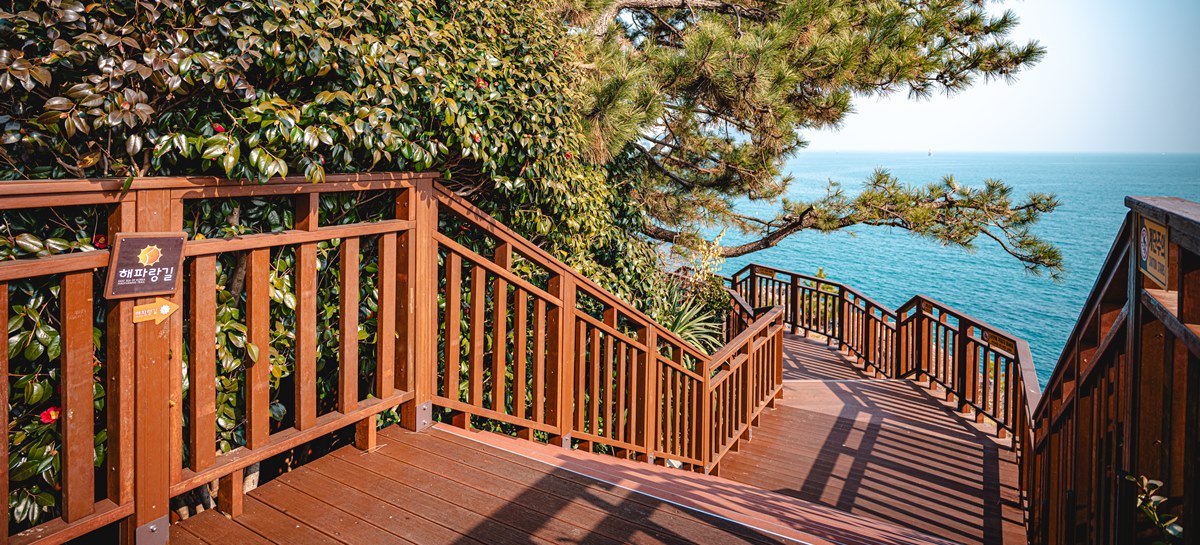
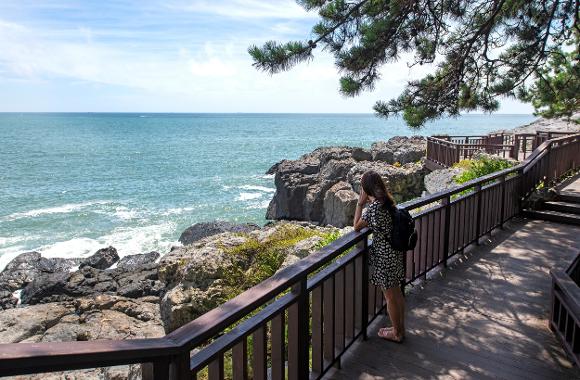
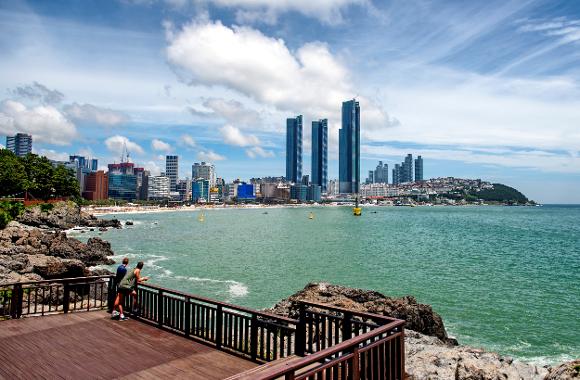
Entering the coastal boardwalk from the beach side gradually exchanges an open sandy panorama for a much closer rocky shoreline. Steps take you down and up again, changing the height from which you see the water. From above, the relationship between the beach and its tall buildings becomes clearer; lower down, water moving into and out of the gaps between rocks becomes the main event. Pine branches, shaded sections and the curve of the railing are part of the experience too. Look up from your phone at each bend and compare the view ahead with the one behind. A short path then becomes a sequence of viewpoints rather than simply a connection between attractions.
Where the walkway narrows, people taking photographs and people continuing their walk can easily get in one another’s way. Stop in wider viewing areas and keep moving on steps and bridges. Being close to the rocks does not mean you need to climb beyond the railing: the changing levels of the path already provide several useful angles on the waves and shoreline. After rain, wooden decking and stairs may be slippery, so footwear with a reliable grip is sensible. If part of the coastal route is closed, use an open interior path instead. Connecting available sections makes for a more comfortable visit than insisting on completing one particular route regardless of conditions.
Princess Hwangok: a story of longing beside the sea
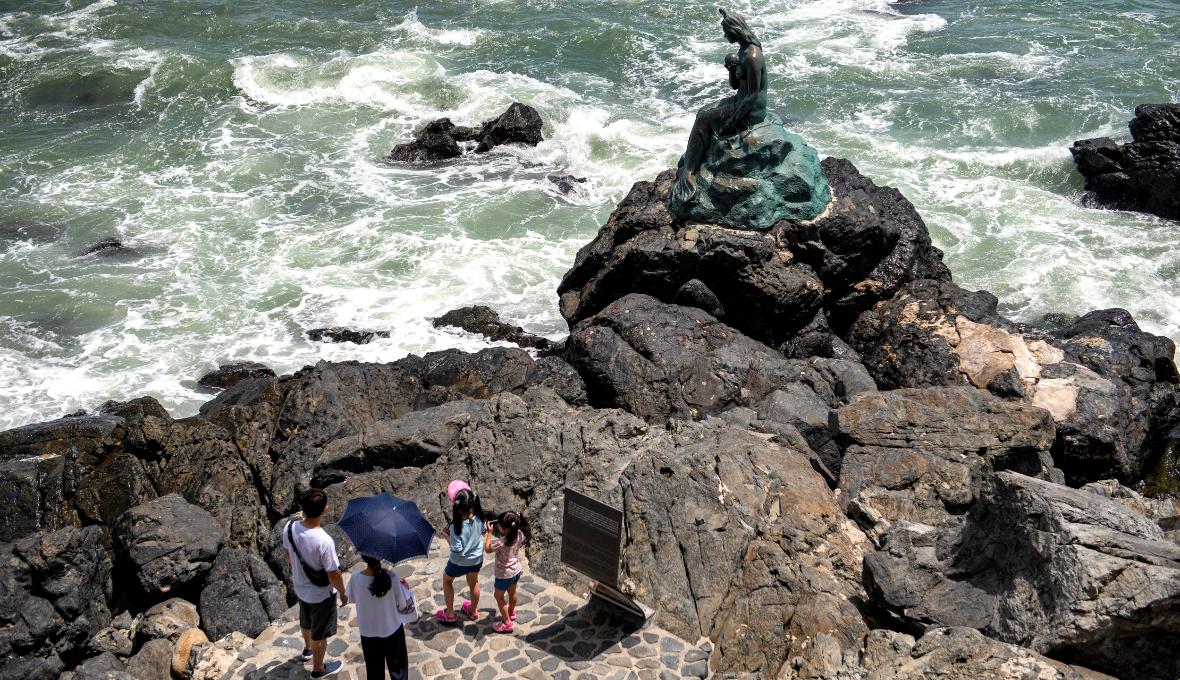
The mermaid statue seated on a rock is one of Dongbaekseom’s defining sights. Local legend tells of Princess Hwangok, who married into a kingdom across the sea and missed the home she had left behind, finding comfort in the moon and water. Read this as a story about longing and migration, rather than documentary proof of a royal marriage between historical states. For an overseas visitor, its emotional centre may feel surprisingly familiar. Enjoying an unfamiliar, beautiful place does not prevent you from missing the people and language of home. The figure facing the horizon gives that mixed feeling a visible form within a popular tourist landscape.
The sculpture itself also has a history. The first mermaid statue was erected in 1974, damaged by a typhoon in 1987 and replaced by the present bronze figure in 1989. It should therefore not be described as an ancient object that has survived unchanged. The legend and the public artwork operate on different timescales; the artwork has experienced destruction and renewal. Try comparing a closer photograph of the figure with a wider image including rocks, waves and Haeundae’s buildings. One concentrates on the pose and expression of the sculpture, while the other explains where this legendary figure sits in the modern city. Both perspectives help the story make sense.
A short suspension bridge changes the rhythm
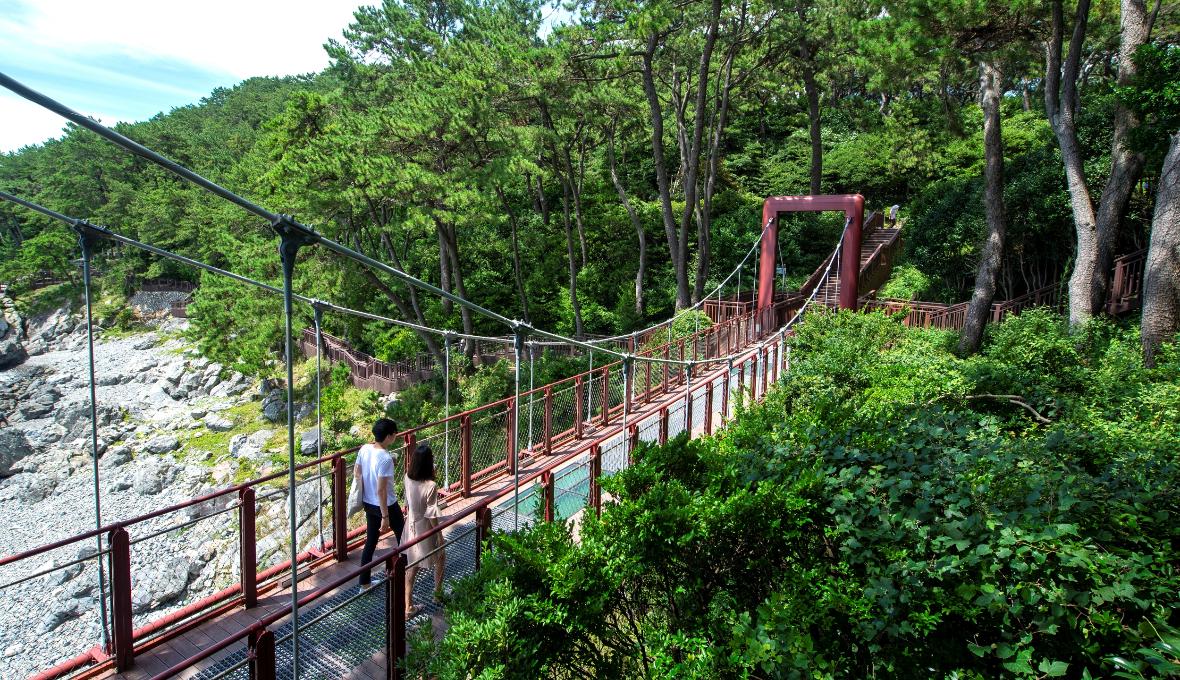
Between the mermaid statue and the lighthouse, a short suspension bridge with red structural elements adds another perspective to the coastal walk. This is not a vast mountain crossing, but moving between trees and rocks while looking sideways towards the sea gives the route a different rhythm. The fine lines of the bridge contrast with the thick pine branches around it. Sections where you can see below the deck can also make the height more noticeable. A short crossing is not automatically comfortable for everyone. If heights or movement beneath your feet are unsettling, assess the entrance and choose a route that feels manageable rather than treating the crossing as compulsory.
For a photograph showing the whole bridge, wait in a safe space near an entrance instead of asking companions to hold their position in the middle. The railings can lead the eye towards the water, and a passing walker provides a natural sense of scale. Avoid stopping as a large group or deliberately shaking the structure: it is a walking connection, not an amusement ride. After crossing, take a moment to look back. The path returning towards the beach has a different character from the one continuing towards the lighthouse. Looking in both directions often adds more to the experience than searching for one supposedly perfect photo spot.
Make sense of Busan’s coast from the lighthouse lookout
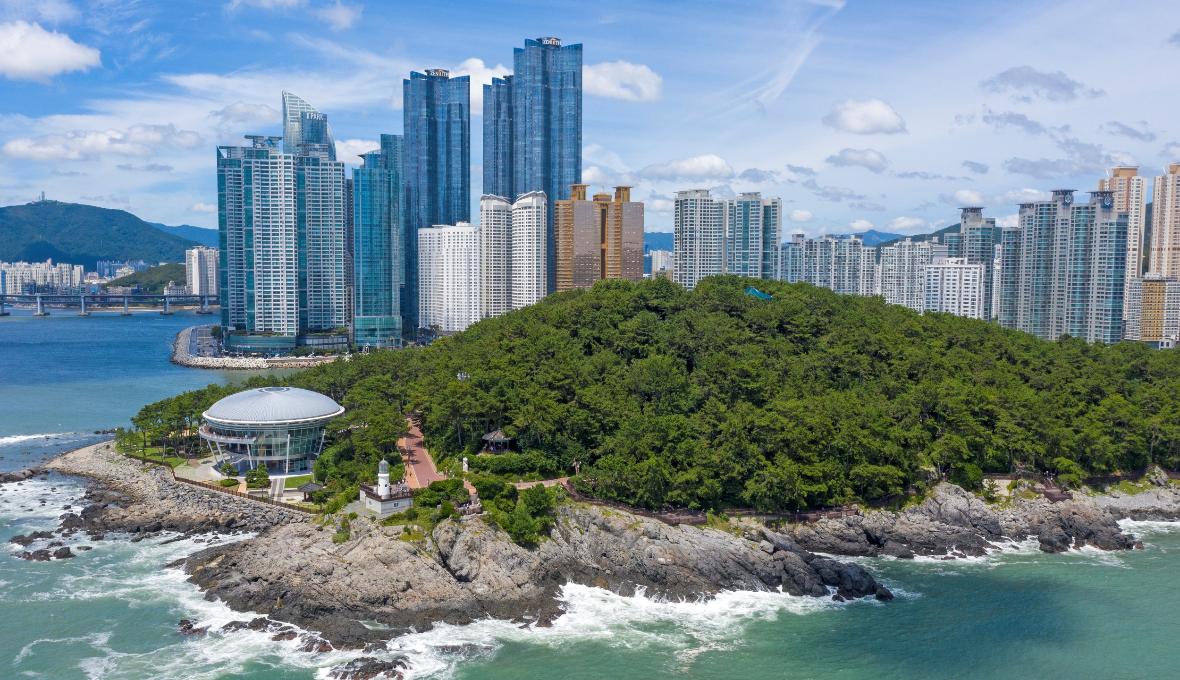
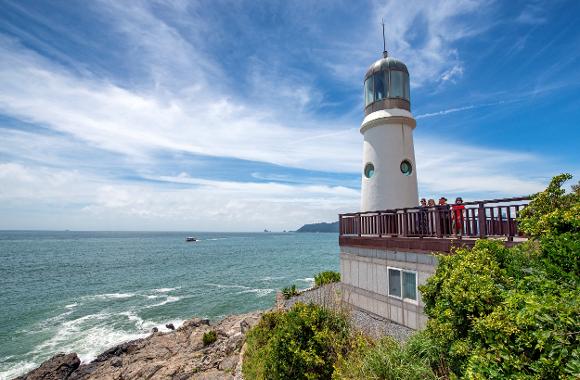
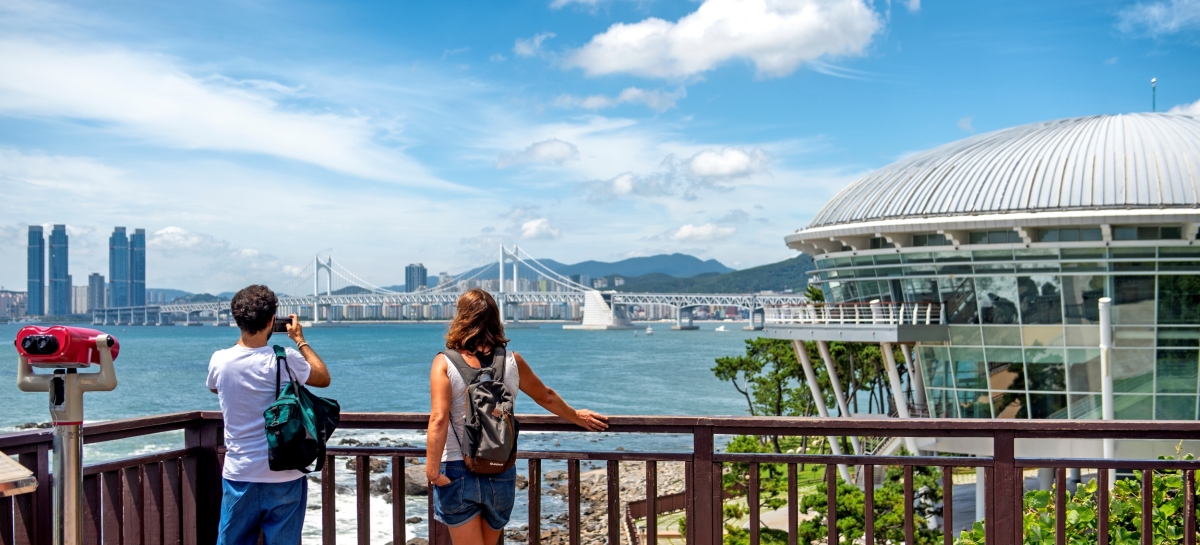
The lookout around the white lighthouse is a good place to bring Dongbaekseom’s different views together. Turn one way towards Haeundae’s beach and buildings, and another towards Nurimaru’s rounded roof and the sea in the direction of Gwangan Bridge. Vertical residential towers, the long horizontal bridge and the low wooded ridge form distinct layers. More distant features such as Oryukdo depend on weather and atmospheric clarity. Do not expect every named landmark to appear sharply at once. Instead, use the visit to distinguish the shoreline and structures that are actually visible that day. Even familiar landmarks can feel different when seen from a wooded headland rather than a city street.
There are photographic possibilities beyond placing the lighthouse in the centre of a souvenir portrait. A railing or branch near the edge of the frame can add depth to a view of Nurimaru and the water. Looking back towards Haeundae creates a contrast between woodland in the foreground and the city beyond. In bright daylight, differences in brightness between sky and sea can leave buildings dark on a phone screen; changing direction slightly may work better than forcing the same composition. Lower sunlight can soften the colours, but its direction and sunset time change with the season. Treat the lookout as somewhere to observe the light, not a guarantee of a particular sunset image.
The architecture beneath Nurimaru’s rounded roof
Nurimaru APEC House hosted an APEC leaders’ meeting and luncheon on 19 November 2005. Its glass and metal exterior looks contemporary, yet the design draws on the traditional Korean pavilion, or jeongja. The overall form interprets that pavilion in a modern way, while the roof evokes Dongbaekseom’s ridge. Twelve sloping exterior columns are another feature worth noticing. From a distance, consider how the roof meets the line of the woodland. Up close, look at the spacing between columns and the way the glass divides and frames the surroundings. These details turn the building from a conference landmark into a more engaging piece of architecture.
The name combines Korean words associated with the world and a summit. International diplomacy and a recognisably Korean sense of space meet in the building’s purpose and design. On the sea-facing terrace, think about the role of a broad wooden hall or maru as a connection between an interior and the landscape outside. Rather than only photographing the exterior, look out towards the water from inside, then study the building again from outside. The roof and windows acquire a different meaning when you reverse the viewpoint. Some areas also serve event functions, however, so do not assume that every floor and room is part of the public visit. Follow the designated visitor route.
How to give the meeting room and exhibition more attention
The third-floor visit centres on the preserved 2005 meeting room and the APEC memorial exhibition. Desks, chairs, microphones and nameplates used by the leaders help you picture the practical setting of a diplomatic gathering. Look beyond the initial impression of a large conference room. Compare the arrangement of seats, the distances between participants and the relationship between windows and sightlines. Television coverage usually focuses on statements and faces; here, the organisation of the room becomes visible in its own right. With children or teenagers, this can prompt a useful conversation about what representatives of different countries and regions need in order to meet and communicate in one place.
The exhibition brings together background on APEC, preparations for the 2005 Busan gathering, the leaders’ durumagi outer robes and models recreating the luncheon. The entrance’s Twelve Symbols of Longevity artwork introduces wishes for long life and wellbeing. Choose an interest such as clothing, food or meeting spaces and follow it through the displays rather than reading everything at an identical pace. The food models illustrate a past event; they are not dishes currently available to order. Video and interactive equipment may vary in operation on the day. The preserved room and physical exhibits provide a stronger basis for planning your visit than assuming that a particular digital feature will always be available.
Choe Chi-won and the name Haeundae
Dongbaekseom is central to the story of how Haeundae acquired its name. Tradition associates the inscription on the coastal rocks with Choe Chi-won, a scholar and writer of late Silla who admired the scenery and left characters connected with his literary name, Haeun. The coastal inscription and the memorial area higher in the park tell related stories in different ways. One invites you to think about naming an actual landscape of rock and water; the statues and monuments show how later generations chose to remember an individual. Separating the traditional account from the modern commemorative setting avoids treating everything visible as equally old or equally certain.
The upper area includes a statue of Choe Chi-won, a memorial and Haeunjeong pavilion. It can add a short historical walk to the coastal visit, but reaching it involves extra distance and slopes beyond the shoreline route. If photographs and the exhibition have already taken much of your available time, there is no need to rush to include every feature. Visitors interested in literature and place names should reserve time for it deliberately. The same sea has inspired a legend about missing home and a story about giving a place its name. Dongbaekseom is compelling not only because the landscape is attractive, but because people have found different ways to remember it.
Camellia season, and the woodland beyond the flowers
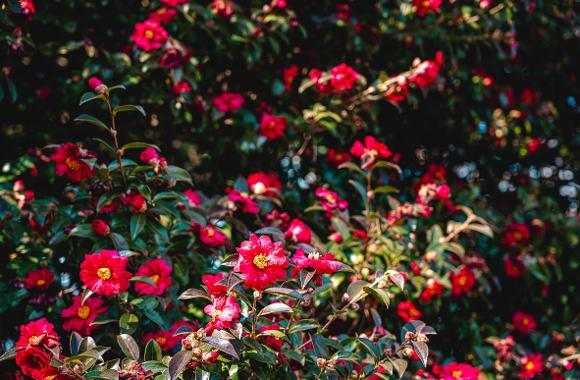
Dongbaekseom’s name makes it tempting to imagine an entire island covered in red camellias. Winter through spring is the period to look for blooms, but actual flowering varies with temperatures and the position of individual trees. Do not expect every part of the park to reach its peak on one fixed date. Look for buds among the leaves, flowers on lower branches and fallen blooms beneath the trees. The contrast between deep green foliage and red petals may appear more clearly at close range than in a broad landscape photograph. There is no need to pull branches towards the camera or pick flowers to appreciate their shapes and colours.
The park remains worth visiting outside the flowering season. Evergreen foliage, pine shade and the meeting of woodland and sea create their own changing atmosphere. In summer, alternate exposed viewpoints with shaded sections; in winter, remember that the coast can feel colder than sheltered city streets when the wind rises. Rain may deepen the colours of trees and rocks, but a photograph is not a reason to persist on slippery steps. Treating flowers as the sole purpose of a visit creates unnecessary disappointment when blooming does not match expectations. Planning for the woodland and sea together better reflects the place, while any camellias you find become an additional part of that day’s experience.
Choose a different approach if you need to avoid steps
An attractive boardwalk photograph does not mean the whole coastal circuit is suitable for a wheelchair or pushchair. The shoreline route includes stairs and narrow passages, so visitors using mobility aids should plan access to Nurimaru separately from the coastal walk. The published accessible approach starts from the designated accessible parking area at Dongbaek Park, follows the lower road beneath the walking path and reaches the first-floor lift for access to the third-floor exhibition. This is not the same route as the deck closest to the sea. Follow the site’s directions rather than choosing whichever line on a map appears shortest.
Accessible toilets are available on the third floor, and the information desk lists free wheelchair loans, with only two chairs available. Availability should not be assumed; contact the venue before setting out if you depend on borrowing one. Groups can first agree on an exhibition and viewpoint that everyone can enjoy comfortably, then let those who wish take a short extra walk along the stepped coastal section. A successful visit does not need to be measured in kilometres covered. Spending time together in a comfortable place can provide more lasting enjoyment than pushing everyone to complete the same circuit. The useful distinction is between the routes, not between who has or has not seen the park properly.
Combine a daytime walk with the evening cityscape
To connect Dongbaekseom with evening views around Haeundae and Marine City, finish the indoor visit first. Nurimaru does not continue admitting visitors throughout the evening. One practical plan is to arrive in the early afternoon, explore the coast and exhibition, then return towards the park entrances as the light lowers and enjoy the surrounding cityscape. This reduces the risk of leaving the building until after admissions close. In winter, when darkness arrives earlier, it also helps to see the coastal steps in daylight. Sunset, building illuminations and the exhibition’s closing time follow different schedules; they should not be treated as one event.
The sunset colours or illuminated skyline in a photograph cannot be guaranteed on your visit. Cloud, wind, visibility and local events all affect the scene. Even a small tripod should be placed where it will not block a walkway or someone else’s view. If strong wind or high waves lead to restrictions, returning by a city-side pedestrian route is a reasonable adjustment. It is often more comfortable to enjoy the coastal walk and the night scenery in separate stretches than to wait on shoreline steps until darkness. Daylight helps reveal the shape of the land; evening gives a different emphasis to the outline of the city.
A relaxed half-day plan for a first visit
With around four hours available, begin at Dongbaek Station, walk to the park and follow the beach-side route past the mermaid statue, suspension bridge and lighthouse before visiting Nurimaru. Allocate roughly two hours within the park for walking and exhibits, then use the remaining time to emerge towards Haeundae Beach for a rest or meal. If the Choe Chi-won memorial area is a priority, extend the overall plan rather than squeezing it between already crowded stops. Work backwards from Nurimaru’s last admission when choosing a starting time. After a late lunch, it may make more sense to visit the exhibition first and walk the coastal route in reverse.
Plan to choose a meal in the surrounding Haeundae streets rather than depending on eating inside the park. Overseas visitors may find it useful to check spice levels, seafood or meat ingredients and minimum order quantities instead of judging a dish from its photograph alone. Bring water and perhaps a light snack for the walk, eat in an appropriate resting area and take your rubbish with you. If you finish on the beach side, Haeundae Station may suit your accommodation or next destination better; returning to Dongbaek Station is not mandatory. The point of a half-day plan is to leave breathing space between walking, exhibits and food, rather than maximise the number of attractions.
Addresses, contacts and opening hours to check before visiting
For Dongbaek Park, use 99 Dongbaek-ro, Haeundae-gu, Busan as an address reference; park enquiries are handled on 051-749-7621. Nurimaru APEC House is at 116 Dongbaek-ro, Haeundae-gu, Busan, with visitor enquiries on 051-743-1974. From an overseas number, use +82-51-749-7621 or +82-51-743-1974, dropping the initial zero from the area code. Although both places belong to the same outing, they have different enquiry contacts and access arrangements. When choosing a map destination or explaining a taxi trip, decide whether you want a park entrance or the approach to the exhibition building. That small distinction can prevent an unnecessary change of route on arrival.
As checked in October 2026, Nurimaru opens from 09:00 to 18:00, with last admission at 17:00, closes on the first Monday of each month and charges no admission fee. Walking in the park is also free, while nearby parking is charged separately. The park’s general all-hours access should not be read as a promise that the exhibition or every coastal section is always open. Follow current notices for events and weather-related restrictions. Dongbaekseom offers plenty to explore without adding a costly activity: a legend beside the mermaid, the thought of an international gathering in the meeting room, and a changed angle on the sea as you leave can make one walk feel like several stories of Busan.
Reviews 1
Route choices
Public visitor review summary
I appreciated coastal paths, a forest return option and useful information boards along the way.
A little closer to Korea.
Thank you for reading.