A different way to see Busan’s sea
Taejongdae is more than a sea view. At the southern end of Yeongdo Island, forest paths open onto a horizon above layered rock cliffs and breaking waves. The perspective is quite different from sitting on the sand at Haeundae: here, ships, a white lighthouse and a dark green headland share the same landscape. For travelers who want both the energy of Busan’s port and a quieter encounter with its coast, Taejongdae deserves half a day rather than a brief stop for a photograph.
The most useful decision is how much walking you actually want to do. A lighthouse that looks close on a map can take considerable time once you descend the coastal stairs and climb back. Equally, you do not have to complete every path to enjoy the park. Spending time at the observatory and walking a shorter stretch of forest is a worthwhile visit. Allow roughly two and a half to four hours within the area as a planning estimate, including pauses and local movement; travel from your hotel or Busan Station comes on top of that.
A royal legend and a much older landscape
The name Taejongdae is associated with a legend about King Taejong Muyeol of Silla, who is said to have admired the scenery and practiced archery here. He should not be confused with King Taejong of the later Joseon dynasty. Treat the story as a local naming tradition rather than a documented royal itinerary. The rocks tell a far older story: sediment deposited in a lake during the Late Cretaceous became rock, the land rose, and waves later shaped the exposed coast. Not every cliff beside the sea began its life as a marine deposit.
You need not memorize geological terms to notice this history. Follow a line through the rock, look for changes between lighter and darker layers, and watch where waves meet the cliff. A seemingly uniform gray wall becomes a landscape of seams, slopes and fractures. Start with a broad view of forest, rock and water, then look more closely at the patterns. If an information board marks an area as closed, observe it from an open viewpoint. People standing on a rock in an old photograph are not evidence that visitors may stand there today.
Check the wind as well as the forecast
When choosing a day, consider wind, rainfall and coastal restrictions alongside temperature. A mild afternoon downtown may feel very different on an exposed headland. Rain can make forest paths and stairs slippery, reduce visibility and disrupt the internal transport service. In strong wind, a hooded outer layer is often easier to manage than an umbrella. Before descending toward the coast, lighten your bag to the things you need, such as water, an extra layer and your phone. Keeping both hands available makes stairs more comfortable.
Admission to Taejongdae Park is free. The park’s published access hours are 04:00–24:00 from March through October and 05:00–24:00 from November through February. These are not the opening hours of every facility, coastal area or shuttle service. Coastal access is restricted at night, and the lighthouse has its own visiting hours. For a first visit, arrive in daylight and finish the main walk before sunset. In winter, morning or early afternoon gives you more flexibility; in summer, allow regular breaks from the heat. Photographs of summer hydrangeas should not set expectations for an autumn visit.
Take the metro, then a bus to Yeongdo
There is no metro station at Taejongdae’s entrance. From Busan Station on Line 1, use Exit 7 as your starting point and locate the stop opposite the Kyowon Building for a Taejongdae-bound 88 or 101 bus. The operator’s guidance gives about 40 minutes for the bus journey, but waiting time and traffic can change the total considerably. Before boarding, check the stop display or a map app for the direction and destination. Catching the correct number on the wrong side of the road can send you on a substantial detour.
From Nampo, start at Exit 6 of Nampo Station on Line 1 and the stop opposite Lotte Department Store; services toward Taejongdae include buses 8, 30 and 88. The published estimate is about 30 minutes, with extra margin sensible on busy weekends. Travelers coming from Seomyeon can take Line 1 to Nampo and connect there. Search for ‘태종대유원지’ or 24 Jeonmang-ro, Yeongdo-gu, Busan. After getting off, check your position relative to the entrance rather than following the crowd automatically, and save the location of the return stop while it is easy to identify.
The current service is a free replacement bus
The operating notice checked on 30 October 2026 states that the Danubi train is suspended for a safety inspection, with a free circular bus running until the inspection is completed. Older accounts of train fares and departure intervals should therefore not be used as current instructions. The replacement bus is listed as operating Wednesday to Sunday, with no service on Monday or Tuesday. Tickets are issued from 09:10 to 17:30, and buses operate from 09:30 to 17:30. Holiday arrangements and weather can affect the service, so check again on your travel date.
Free travel does not mean immediate boarding whenever you arrive. Obtain a free ticket for a particular departure at the counter; capacity is limited and tickets can run out. The route is Danubi Plaza, Observatory, Yeongdo Lighthouse, Taejongsa Temple and back to the plaza. Passengers may get off and reboard at stops, but must allow for waiting and available seats. On arrival, establish whether the service is running and when your last practical return is before setting off. For circular transport enquiries, call 051-405-8745, including to ask whether the train has resumed.

Choose a circuit or a shorter visit
The current replacement-bus notice describes a circuit of approximately 3.8 kilometers, while some park material gives around 4.3 kilometers for the full circular road. These figures use different reference points; neither should be read as a promise of an easy, level four-kilometer stroll. The observatory and lighthouse stops are close along the road, but descending into the lighthouse’s coastal area and climbing back is an additional effort. If you become tired sooner than expected, reduce the number of stops. The headland is more rewarding when looking at the sea takes priority over rushing between pins on a map.
Keen walkers can use the circular road as a framework, linking the observatory and lighthouse before returning via the Taejongsa area. To reduce uphill walking, take the replacement bus to the observatory and explore a shorter open section on foot. If members of your group have different abilities, some may choose the coastal stairs while others rest at a viewpoint. Agree on a specific meeting place and time first. A clearly identified building entrance is more reliable than an arrangement that depends entirely on phone messages and finding one another among several viewing areas.
The forest is part of the destination
There are stretches where trees hide the sea, and that is part of Taejongdae’s character. If you expect uninterrupted waterfront views, you may miss the pleasure of moving from shade into a sudden opening of sky and water. Light through leaves, branches moving in the wind and the bends of the path offer things to notice before you reach the observatory. Surfaces change between road, wooden decking and steps. Stop in a broad, safe place to frame a photograph instead of walking backward while looking at your screen.
For forest photographs, you need not wait until every other visitor disappears. Leave comfortable space ahead and use the curve of the path; a person in the distance can help show the height of the trees and the scale of the slope. Large bags and tripods should not obstruct the route. Rather than playing music aloud, listen to the changing sounds of wind and waves as the path opens and closes. Keep snack wrappers in your bag until you find an appropriate bin, and resist unofficial tracks that appear to offer a shortcut down the hillside.

Read the headland from the observatory
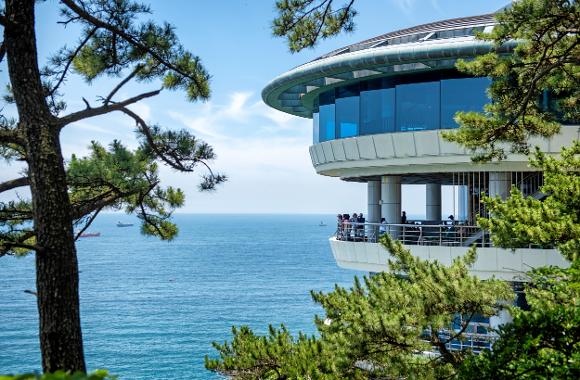
The observatory is a useful place to understand the landscape before choosing the next part of your walk. Its rounded building above the cliffs creates a different shape against the sea from the lighthouse’s tall vertical tower. On clear days, distant islands may become part of the view, but do not expect Tsushima or Oryukdo to be sharply visible on every visit. Haze and cloud alter the experience. Looking first at nearby rock formations, then at passing ships and finally toward the horizon helps convey distance without turning the visit into a search for one elusive landmark.
Pause here for water and check how everyone is feeling. If the wind is uncomfortable or someone has knee pain, make this area the center of your visit and enjoy it properly. If you plan to descend toward the lighthouse, consider the climb back and the transport timetable together. The short distance between the two stops on the road does not describe the effort involved in reaching lower coastal spaces. You can decide after seeing the conditions. A comfortable change of plan is often more useful than faithfully following a schedule made before you arrived.
Yeongdo Lighthouse: navigation and coastal stairs
Yeongdo Lighthouse first lit its lamp in December 1906. Initially known as Mokdo Lighthouse, it changed names before becoming today’s Yeongdo Lighthouse. Its white tower against blue water makes a striking photograph, but its original purpose is to guide ships. Exhibition and cultural spaces around the lighthouse add a sense of port history to the scenery. If you want to enter indoor facilities, check which spaces are open when you arrive. This remains a working navigational setting as well as somewhere visitors come to enjoy the view.
Published visiting hours are 10:00–17:00, with closures including Mondays, 1 January, Seollal and Chuseok; individual arrangements can change. The enquiry number is 051-405-1201. The coastal stairs often feel easier on the way down than on the return climb, so allow time for both movement and photographs. Avoid starting a hurried descent just before the last bus. The view of tower and sea from an upper position can be satisfying in its own right. Stay within open visitor areas, rather than climbing on railings or blocking steps to obtain a particular pose.

Sinseon Rock is currently closed to visitors
The broad rock platforms in older photographs may tempt visitors to imagine walking out across Sinseon Rock. Current park guidance, however, marks access as closed because of rockfall and collapse risks on the approach slope. An old travel post does not override a present-day barrier or closure sign. Seeing the shape of the rocks and standing directly on them are different experiences. Plan to appreciate the coastline from official viewpoints that are open, and accept that a photograph taken under different conditions may no longer be reproducible from the same position.
Look for the interplay of near-horizontal layers and cracks in the cliff. Over long periods, waves exploit weaker areas and shape sea cliffs and wave-cut platforms. Remembering that this landscape was not created by a single dramatic storm adds depth to a short moment of looking. Near the coast, remain behind the railings instead of leaning forward to follow spray or a breaking wave. Dark, wet rock may be much more slippery than it appears. Waiting for changes in light and water from a safe position offers a better photographic opportunity than crossing a boundary.

Slow down at Taejongsa Temple
Taejongsa provides a quieter pause after the exposed coast. Founded in 1976, the temple also has connections with Buddhist relics and bodhi trees brought from Sri Lanka. Where the observatory and lighthouse direct your attention into the distance, the temple brings it closer: to buildings, a courtyard and trees. Including it toward the end of the circuit can give the visit a gentler rhythm after the sea wind and stairs. If you intend to return by bus, check how much operating time remains before settling in for a longer look.
The temple is also known for hydrangeas, but their condition depends on season and weather. Do not assume full bloom or a festival on the same dates every year. A visit outside the flowering season can still offer a calm setting. Keep conversation low when worship is taking place, and follow the local rules for entering or photographing prayer halls. Thinking of the temple as a place where people pray, rather than simply a backdrop, makes the etiquette straightforward. When taking portraits, check that worshippers’ faces do not become prominent unintended subjects in your photograph.
Keep pebble beaches and meals optional
The surrounding coast includes areas known as the Lighthouse Pebble Beach, Taewon Pebble Beach and Gamji Pebble Beach. These names should not be combined in your mind into one flat, continuous beach walk. Their approaches, gradients and current access conditions differ. On a first visit, complete the observatory-and-lighthouse route before deciding whether you have time and energy for another area. If you want a meal close to the water, establish that the approach is open and understand the return route to the entrance or bus stop before committing to it.
At nearby restaurants or seafood stalls, ask what a dish contains, how it is prepared and whether the displayed price is per person or per plate. If raw seafood is unfamiliar, ask about cooked options; explain any allergy clearly, including concerns about side dishes. Do not infer portion size or everything included in an order from a photograph alone. If you have no particular restaurant in mind, a light snack during the walk followed by a meal back in Nampo can be simpler. Leaving lunch flexible avoids turning coastal stairs and transport connections into a race against a reservation.
Visiting with children or limited mobility
The entrance tourist information center advertises free wheelchair and stroller loans from 10:00 to 17:00. Strollers are intended for children under 24 months, and identification is required. Availability depends on stock and weather; enquire on 051-403-4685 or 051-860-7866. A loan service does not mean the whole park offers a step-free route. There are slopes and stairs, and the wheelchair boarding arrangements of the replacement bus need separate confirmation before travel. Plan around the actual route and equipment available to your group, rather than assuming that every attraction can be reached in the same way.
With children, the lower lighthouse area need not be a compulsory goal. Looking for different ships or tracing lines in the rock can turn a shorter forest-and-observatory visit into an engaging outing. Wear comfortable shoes with useful grip, bring water and a light outer layer, and leave heavy luggage at your accommodation if possible. For someone with limited mobility, offer choices based on open paths and available rest points rather than an unverified estimate of the number of steps. Removing the expectation that everyone must reach every viewpoint usually makes shared time more enjoyable.
A flexible half-day plan and the journey back
For a morning arrival, an illustrative plan is 15–20 minutes at the entrance to establish transport and return arrangements, 30–40 minutes around the observatory, and 45–60 minutes for the lighthouse area. Allow another 30–45 minutes for forest walking or Taejongsa, with additional time kept for waiting and rest. These are planning suggestions, not measured completion times. Waiting for a bus or lingering over photographs can extend the visit; skipping the coastal stairs can shorten it. Choose the two places you most want to see before adding every stop to the day.
Afterward, return toward Nampo and Jagalchi for a meal and an urban walk, or add one other Yeongdo destination as a separate journey. Places that look close on an island map are not necessarily joined by an easy walk. If you have a train to catch at Busan Station, leave a generous margin for bus waiting and road traffic. The useful measure of the visit is not the number of photographs collected. A first glimpse of the horizon beyond the trees, the pattern of waves against rock, or wind near the lighthouse can be enough to make the half-day memorable.

Reviews 1
Exercise or sightseeing?
Public visitor review summary
I valued the hilly loop for exercise but found the sightseeing less compelling.
A little closer to Korea.
Thank you for reading.